From Search Engines to Decision Engines
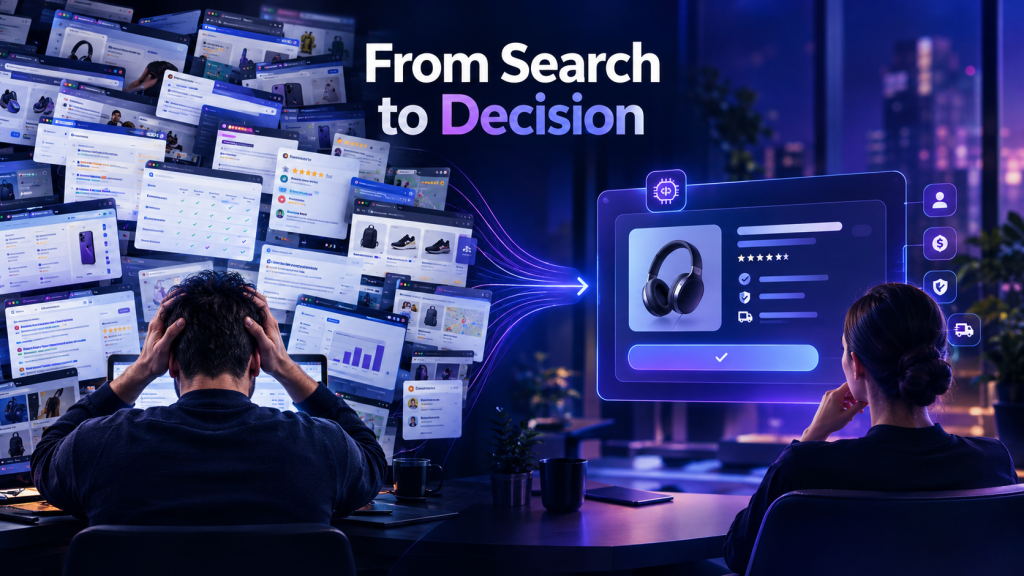
If users start describing their needs instead of searching for products, one of the internet economy's most fundamental habits could change.
I recently went through a familiar process while buying a new pair of headphones. I opened dozens of product pages, compared specs, read reviews, watched videos. After a while, I found myself back on the very first product page I had looked at. As the options multiplied, deciding didn't get easier - it got harder.
Most of us do the same thing when choosing a new phone, a hotel, a flight, or a credit card. The purchase itself takes a few minutes, but the research required to get there can take hours, sometimes days. At that point, people inevitably ask themselves:
Do we actually want to research products, or do we want to reach the right option for our needs with as little effort as possible?
No one lives to compare dozens of headphone models. What we actually want is for our need to be correctly understood and for the right options to be found for us. To understand why Agentic Commerce is being talked about more and more, it helps to start with this everyday behavior. The question isn't just whether AI can recommend better products; it's how much of the research, comparison, and elimination burden currently sitting on the user it can take over.
The Habit the Internet Was Built On
Devices, platforms, and payment methods have changed a lot. Even so, the underlying behavior has stayed almost the same: when a need arises, we search first. The user becomes aware of a need, searches, evaluates the options, and decides.
Google's real success was positioning itself at that first stop. It captured the user's intent before a purchase decision had even formed. SEO, digital advertising, and content marketing all grew up around that moment, because the gateway to a purchase decision was usually the search box.
So if users start describing what they want instead of searching for it, can this economic model keep working?
From Searching to Defining a Need
Today, a user looking for a laptop types keywords, compares specs, reads reviews, and tracks prices. The burden of research and the risk of the decision still rest on them.
With AI-powered systems, this behavior is starting to change. Instead of simply typing "laptop," a user can now say, "I travel often, I join online meetings, I want long battery life." At that point, they're not searching for a product; they're describing their problem, their priorities, and their constraints.
Maybe we've been focused on the wrong thing for years. Most of the time, a user doesn't want a laptop; they want a tool that lets them do their job without friction. They're not searching for a hotel; they're searching for a comfortable vacation experience. They're not searching for a credit card; they're searching for benefits that match their own spending habits.
This may be exactly where Agentic Commerce starts: not so much helping people find products, but trying to understand their needs.
From Search Engine to Decision Engine
Today's search engines show the options; the user makes the decision.
So what happens if a system starts evaluating and narrowing down the options on our behalf, taking our budget, habits, and priorities into account?
At the center of a search engine is access to information. At the center of a decision engine is the user's goal and the best way to reach it.
The big shifts in the history of technology have usually been adopted not because people found the technology impressive, but because it made some process easier. The motivation behind Agentic Commerce lies largely in the same place.
Where Will Brands Show Up?
Today, brands invest in ranking higher in search results, running ads, and grabbing attention, because a human makes the decision, and winning their attention comes first.
But if an agent takes over the first stage of research, visibility alone may not be enough. If the price isn't current, stock information is missing, product data isn't structured correctly, or the system can't compare the product with other options, the brand may end up ranked lower in the agent's evaluation.
In that case, brands may need to restructure their product data into a form that machines can correctly understand and compare. Data accuracy, freshness, clarity of delivery and return terms, API quality, and the consistency of structured data could all become far more strategic.
The phrase "earning the agent's trust" may sound compelling, but it can be a bit misleading. Agents don't form emotional trust; brands simply try to position themselves favorably within the agent's evaluation criteria.
Today, brands tell stories to persuade people. Tomorrow, they'll also need to back those stories up with verifiable data.
Will SEO Be Enough?
SEO's importance won't disappear entirely. Branches didn't vanish when mobile banking became widespread; search engines will likewise keep a place in our lives even as AI becomes widespread.
But simply asking "Where do we rank in search results?" may no longer be enough.
More important questions might be:
- Is our product data defined in a form machines can process?
- Is our data up to date?
- Are our delivery and return terms comparable?
- Can an agent draw a meaningful connection between the customer's need and the solution we offer?
This is exactly where the new competitive battleground could form.
What Does This Mean for Turkish Fintech?
In Turkey, comparing credit products, as well as participation (Islamic) and conventional banking solutions, is difficult. On the payments side, businesses often have to work with more than one infrastructure provider as well.
Agents could change this picture in two different directions.
On the risk side, if customer traffic concentrates on a handful of large agent platforms, fintech companies' direct relationship with their customers could weaken.
On the opportunity side, if regulators establish common data standards, that could bring all players onto the same playing field. In that scenario, competition could be shaped far more by data quality, operational excellence, and trust than by marketing budgets.
Where Could This View Be Wrong?
Technology could mature more slowly than expected. People may not want to delegate their decision-making. Brand loyalty could prove stronger than expected. Regulations could also limit how much room agents have to operate.
For that reason, it may be more accurate to read today's trends not as a settled direction, but as a hypothesis that needs to be watched carefully.
Is Search the Only Thing Changing?
If customers stop searching, how will brands reach them, and how will today's traffic-driven economy keep working?
In all likelihood, classic search, AI-generated answers, and agent-driven research will coexist for a long time. But even just users starting to describe their needs instead of searching for products may be enough to shift the current balance.
Economic models usually transform not when new technology first appears, but when user behavior starts to change.
If users start leaving part of their research to agents, a door may open onto a new era moving from search engines toward decision engines.
Next Up: Decision Authority
In the next post, I'll focus on the decision itself.
Leaving research to an agent can be a matter of convenience. But delegating the authority to choose and to buy brings a very different discussion with it.
Because delegating the burden of research and delegating decision-making authority are not the same thing.
Should AI just offer us options, or should it also be able to decide on our behalf, within the boundaries we set?
The answer to that question will show that Agentic Commerce isn't just a technology trend; it's also an ethical, legal, and sociological transformation.