Are We Ready to Give an AI Agent the Authority to Make Payments?
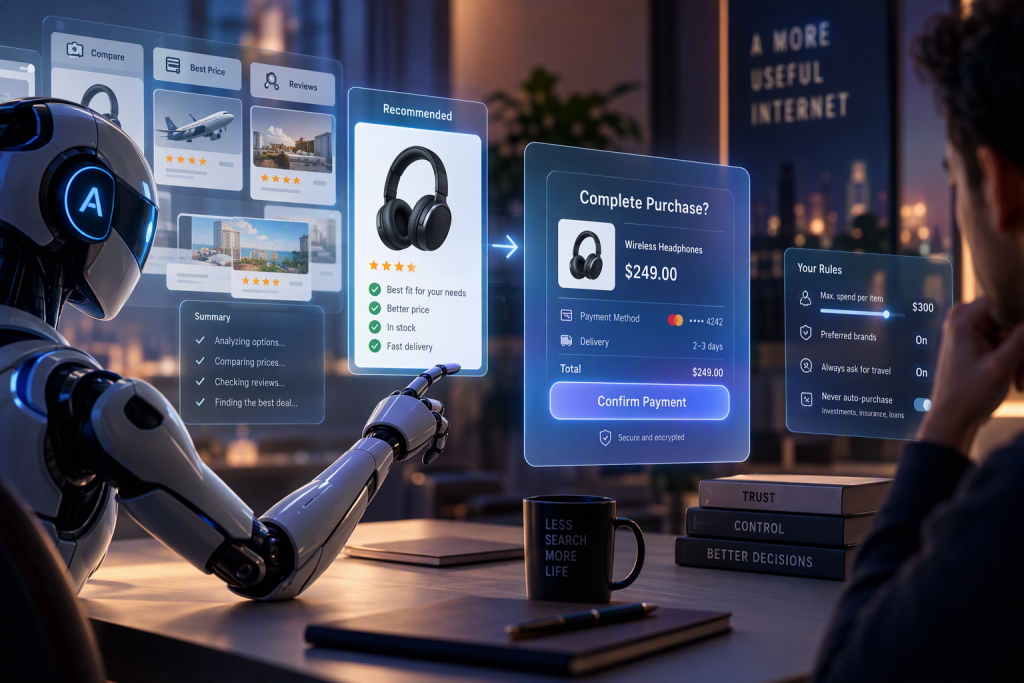
Having long looked at complaint and dispute processes related to payment systems, I think granting an agent payment authority is a much different matter than research or product selection. It's easy to accept an agent researching products and comparing options on our behalf; letting it spend money from our card or account is an entirely different matter.
In the previous post, we talked about how much decision-making authority we could delegate to AI agents. An agent can scan hundreds of options, compare prices, and prepare a meaningful recommendation for us. That genuinely makes things easier. Over time, we may also get used to trusting an agent with low-risk, repetitive transactions within the limits we define.
But once a decision is made, the job isn't done. The chosen product still has to be paid for. That's where the real weight of Agentic Commerce lies, on the payment side.
Most of today's payments are built around a model where a human initiates, or at least approves, the transaction. We use the card, approve it through a mobile app, or pay with our wallet. Even if other systems operate in the background, the intent to pay is considered to belong to the user.
Saying “find the best flight” is easy. But when we say “pick the suitable one within my budget and pay for it,” we are granting the agent the authority to act on our money.
The real question: within what boundaries should an AI agent be allowed to use our money?
Is It All or Nothing?
Dividing an agent's payment authority into simply “I allow it” or “I don't” isn't realistic. We don't manage authority that crudely today either. We put limits on cards, require extra verification for certain transactions, disable certain transaction types, and define different approval levels by amount in corporate structures.
The same logic can be applied to agents. A spending limit can be defined for products we buy regularly. The agent could complete the transaction within that limit, ask for our approval once the amount rises, and may be barred from paying directly at all in sensitive areas like health, investment, or financial products.
This way, we aren't granting the agent unlimited spending authority. We define its scope of action, its limits, its duration, and its conditions.
At the core of this model there is neither a new technology nor an unknown mechanism. Tokenization, which keeps card details out of the agent's hands, extra verification that kicks in under certain conditions, and the scope- and time-limited consent used in open banking are all already in use today. What's changing is that these tools will now be used together to manage the authority of software acting on a person's behalf.
Which Payment Instrument Will the Agent Choose?
Suppose an agent picks a plane ticket on our behalf and buys it up to a certain amount. Will it pay by card, by bank account, or by digital wallet?
Today we make that choice ourselves, and the decision doesn't depend only on which account has a balance. One card might earn more points while another offers an installment advantage; paying from an account might cost less, or a digital wallet might offer a campaign specific to that transaction.
As agents take on a bigger role in purchasing decisions, they may also decide how to make the payment in the most advantageous way. At that point, choosing the product and choosing the payment instrument become part of a single decision flow.
This could also change the competition among banks, cards, and wallets. Today, payment instruments compete to win a human's preference. In the near future, standing out in an agent's evaluation criteria may matter just as much.
The question banks have asked for years has been, “Why should the customer use my payment instrument?” Now a new question may be added:
Why should the agent choose my payment instrument?
The answer may not lie only in campaigns or points. Transaction cost, security, ease of refund, and how easily the payment instrument can be integrated into the system could also influence the choice.
Who Is Considered to Have Made the Payment?
From a payment-systems perspective, one of the most critical issues is being able to clearly determine on whose behalf and under what authority a transaction was made.
A user may grant an agent purchasing authority. But if the agent is the one initiating the transaction, the system needs to see not just the user, but the scope of the authority granted. The agent shouldn't be treated as a stand-in for the user. It should be a separate actor, authorized by the user, with clear boundaries, a defined duration, and the ability to be revoked.
Accountability, meanwhile, becomes more complex than it is today. The user, the agent, the platform providing the agent, the merchant, and the institution processing the payment can all be part of the same transaction. If a card is used, the card scheme joins the chain; if a wallet is used, the wallet provider joins it too.
When a wrong payment happens, the question “Who made the transaction?” isn't enough on its own. It should also be possible to later see what the authority was, how the agent used that authority, why it chose that particular payment instrument, and under what conditions the financial institution accepted the transaction.
Consider this: the user gave the agent permission to act within a budget, and the agent spent the entire budget in a single transaction. Was the authority violated? Or it didn't exceed the amount limit, but it dealt with a merchant the user would never have chosen. If the system didn't technically break any rule but still misread the user's intent, how would the dispute be handled?
For these questions to be answerable, the authority the user granted, the decision the agent made, and the control steps the transaction passed through all need to be traceable. This isn't just a technical requirement; it's one of the fundamental pieces of trust. Beyond making the right payment, the agent should also be able to show why, and based on which rule, it made that payment.
While reviewing payment-related complaints, I came across many customers, and one situation I often saw was a customer simply not remembering a transaction they themselves had made. In most cases there was no fraud at all; the customer had made the decision, carried out the transaction, and later forgotten about it. The source of the dispute wasn't always bad intent; sometimes it was just a forgotten decision.
The same situation gets even more complicated when we think of it through an agent. When a user grants an agent a general authority, many small transactions can take place under that authority. After a while, they may not remember which ones they specifically approved, which ones the agent carried out on its own, and under what conditions each transaction occurred. This could cause today's disputes and complaints to show up in a much more intense form.
For this reason, when designing agent authority, simply setting a limit won't be enough. Users should be able to clearly see when, under what authority, and for what reason each transaction was made.
Forgetting is a natural human weakness; systems need to keep the records that make up for that weakness.
Does Every Payment Need to Be Approved?
Requiring approval for every transaction might seem like the safest approach at first glance. But getting a notification and being asked to approve again for every coffee order or every subscription renewal would wipe out most of the convenience the agent provides.
Letting it make payments with no approval at all isn't acceptable either. What's reasonable is creating authority levels that vary based on the amount, the nature of the transaction, and the risk it carries.
These levels can also vary from person to person. Some users may want a fully automatic flow for familiar, low-value payments, while others may want to be informed of every expense and always give approval above a certain amount.
Limits, extra verification, and tiered approval aren't new concepts. What's new is that these mechanisms will be used by software acting on a person's behalf.
What needs to be designed isn't making the user re-approve every transaction; it's determining which transactions the agent can carry out on its own, and which ones need the decision to come back to the user.
How Will the Payment Experience Change?
The payments industry has long been trying to reduce friction. We've saved card details, made contactless payments widespread, developed one-tap experiences, and made biometric verification a part of everyday life.
With Agentic Commerce, we're starting to talk about a different dimension of this approach, because the party initiating the payment may no longer always be human. In such a world, it may no longer be enough for payment infrastructures to keep operating based only on the screens and approval steps that humans see.
What the agent can access, within what limits it operates, and under what authority it initiates a transaction may become more decisive factors.
Card payments, digital wallets, open banking, and account-to-account payment models may each have different strengths within this structure. Which one comes out ahead depends on a more fundamental question:
Are payment infrastructures ready to recognize a digital actor acting on a person's behalf, alongside the person?
Perhaps what will define the future payment experience isn't which button the user presses, but what authority the system acting on the user's behalf holds.
Final Word
Saying “find” is easy. “Choose” requires a bit more trust. When we say “pay,” we start talking about who we're giving the authority to use our money to, under what conditions, and within what limits.
In the future, the most important question may no longer be “Who made the payment?” The more accurate question might be:
On whose behalf, based on what authority, and within what limits was this payment made?
The answer to this question will also determine how much users will trust agents, how financial institutions will evaluate these transactions, and how responsibility will be shared among the parties.
In the next part of the series, I'll look at another side of the purchasing decision:
Will an AI agent show the same brand loyalty we do, or will it recalculate price, points, and real economic benefit from scratch?