Points or Habit?
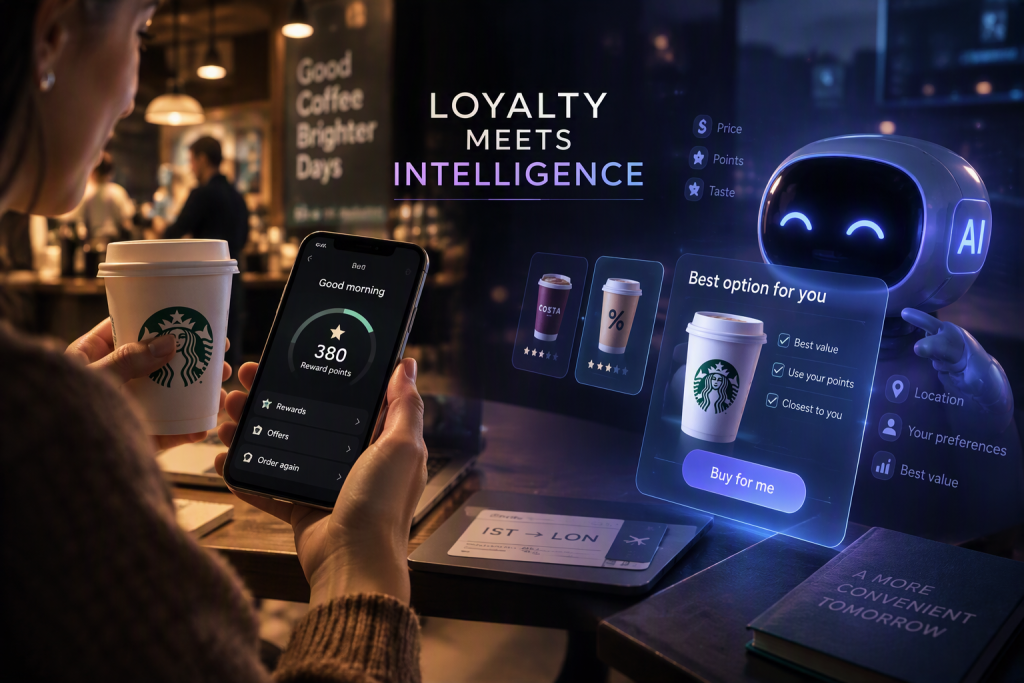
A large part of loyalty programs is built on understanding and steering human behavior. We hand out points, offer discounts, create membership tiers. But when an AI agent starts making purchases on our behalf, does the meaning of these programs change?
In the previous post, we talked about how handing payment authority to an agent isn't just a matter of technology. While thinking about the payment side, another question stuck with me:
Does an AI agent care about Starbucks points?
At first glance this question might seem a little odd. But it actually questions one of the basic assumptions loyalty programs rest on.
Are We Really Choosing?
When thinking about loyalty, we first need to make a distinction. Buying coffee from the same chain every morning doesn't necessarily mean we're genuinely attached to that brand. The store might just be on our way. Using the same card for years might be less because we're convinced it's still the best option, and more because we don't want to deal with switching.
Habit plays a major role in human behavior. If a product meets our expectations well enough, we don't re-research the alternatives every time. We largely repeat the decision we made in the past.
I think an agent could behave differently here. It could do, every single time, the comparison we're too lazy to do. It could check whether the brand that looked most advantageous yesterday still is today, see whether another seller offers the same product cheaper, calculate whether using the current points or taking advantage of another campaign is more economical.
This evaluation, which takes us time, could be a routine step for an agent. In that case, an advantage brands have long relied on could weaken too:
Customer habit.
The Real Value of Points
Collecting points is a behavior familiar to all of us. From credit cards to airlines, from retail to coffee chains, many sectors use similar methods to pull us back into shopping.
But people's relationship with points isn't always mathematical. We might not know the exact monetary value of our points, we might forget their expiration date, we might make a purchase we normally wouldn't just to earn points, or we might leave a significant share of the points we've accumulated over the years completely unused.
There's little reason for an agent to fall into the same trap. It can evaluate together the points offered by different cards, ongoing campaigns, the price of the product at different sellers, and the available payment options. It can calculate whether the high points one card offers are really more valuable than the direct discount of another card.
Today, what matters in loyalty programs is how the user perceives the advantage. In a world where agents take a bigger part in the purchasing process, how much value an advantage actually produces could become more visible.
"10x points" sounds powerful, but an agent will probably look at a simpler question:
What does this actually amount to for the user?
Do Campaigns Affect the Agent Too?
Today's campaign language is largely designed around human behavior. Phrases like "Today only", "Just for you", "Last chance" are often used not just to offer economic benefit, but to steer the user toward a particular behavior.
As humans, we can be influenced by these messages. Sometimes we change our decision because it's genuinely advantageous, sometimes because we don't want to miss the opportunity.
An agent might look at the same campaign differently. Is a 20% discount really a discount? What was the price before the campaign? What's the monetary equivalent of the points to be earned? Is the same product available at another seller, without a campaign, but at a lower price?
If these can be compared within a few seconds, a campaign simply being eye-catching may not be enough on its own. Campaigns won't disappear, but they will have to work in a world where the value they offer is easily compared.
In the future, a good campaign may not be the one shouting "discount" the loudest, but the one that genuinely delivers an advantage in the total-benefit calculation.
Where Does Brand Value Go?
It wouldn't be right to explain everything through price and calculation either. If I've been using a brand for years, that might not be solely about price. I may trust the product's quality, I may be satisfied with its after-sales service, or I may simply like the experience the brand offers.
Almost all the appliances in my home are from the same brand. I didn't choose this deliberately; it happened over time. The first washing machine worked well, then I had no trouble with the fridge either, and at some point it even became hard to consider another brand.
Price matters, of course. But the trust I have in this brand sits well beyond a difference of a few hundred lira. I feel that if I run into a problem, I'll find someone to talk to, I'll be able to get a spare part, and I won't have to go through a long research process all over again. That knowledge reduces the need to redo the whole calculation with every purchase.
Perhaps one of the real values of brand loyalty is exactly this: it removes the need to re-evaluate every option with every purchase.
An agent, on the other hand, might have the capacity to redo that evaluation every single time.
Still, it doesn't feel right to me for an agent to keep switching this kind of preference over a difference of a few hundred lira. The goal shouldn't always be to steer us toward the cheapest option. What's hard is telling apart the choices we genuinely value from the behaviors we merely keep out of habit.
Even people themselves can't always tell the difference.
Do I genuinely prefer this brand, or do I keep using it just because I have for years?
The answer to that question isn't as obvious as we think.
An Agent Loyal to the User
I think the most interesting question for the future of loyalty programs is this: how does the relationship change once an agent steps between the brand and the user?
Today, brands want to keep the customer within their own ecosystem. Points programs, membership tiers, free delivery and exclusive campaigns are largely designed to pull the customer back to the same brand.
When an agent acting on the user's behalf enters the purchasing decision, a new party is added to this relationship.
A person can be loyal to a brand.
But the agent's loyalty has to be to the user.
When the two point in the same direction, there's no problem. If the brand I love still offers a good price, quality service, and a decent experience, it's natural for the agent to choose it too.
What happens when they diverge is a harder question.
If the agent finds a much better alternative, how much should it push back against me? Should it simply carry out my preference as given, or should it be able to say, "This brand is no longer the best option for you"?
Perhaps one of the most valuable traits agents will have in the future won't be carrying out everything we say, but being able to notice when our habits are no longer working in our favor.
In that case, brand loyalty won't disappear, but it will become a little harder to earn.
How Will Loyalty Programs Change?
I don't think loyalty programs will disappear. The bond people form with brands — premium experience, status, access and personal preference — will continue to exist. But programs built solely around bringing the customer back to shop again may need to be rethought.
In the future, a brand may stand out not because it gives more points, but because it presents its price transparently, makes the real value of its points understandable, simplifies the refund process, and genuinely benefits the customer.
In the previous post we asked this question:
Why would the agent choose my payment instrument?
On the loyalty side, there's another version of the same question:
Why would the agent choose my brand?
"Because the user has preferred us for years" may not carry the weight it used to. If the agent is expected to pick the same brand again and again, it won't be enough for the brand to have simply been good in the past. It needs to generate meaningful value for the user in today's transaction too.
Perhaps this will be the most important change for brands. Loyalty may stop being an advantage carried for a long time once earned, and instead become a preference that has to be re-earned with every new transaction.
Final Word
An AI agent can care about our points — but only if those points genuinely create value for us.
I don't think Agentic Commerce will eliminate loyalty. It will simply force brands to re-earn that loyalty with every transaction, instead of relying on the customer's habit.
Rather than diminishing the importance of loyalty programs, this could make them more transparent and grounded in real benefit.
In the next part of the series, I'll look at the bigger picture of competition:
Among the players who can simultaneously reach the customer, the payment relationship, and the decision-making agent, who will be the real winner of Agentic Commerce?