Who Will Win in Agentic Commerce?
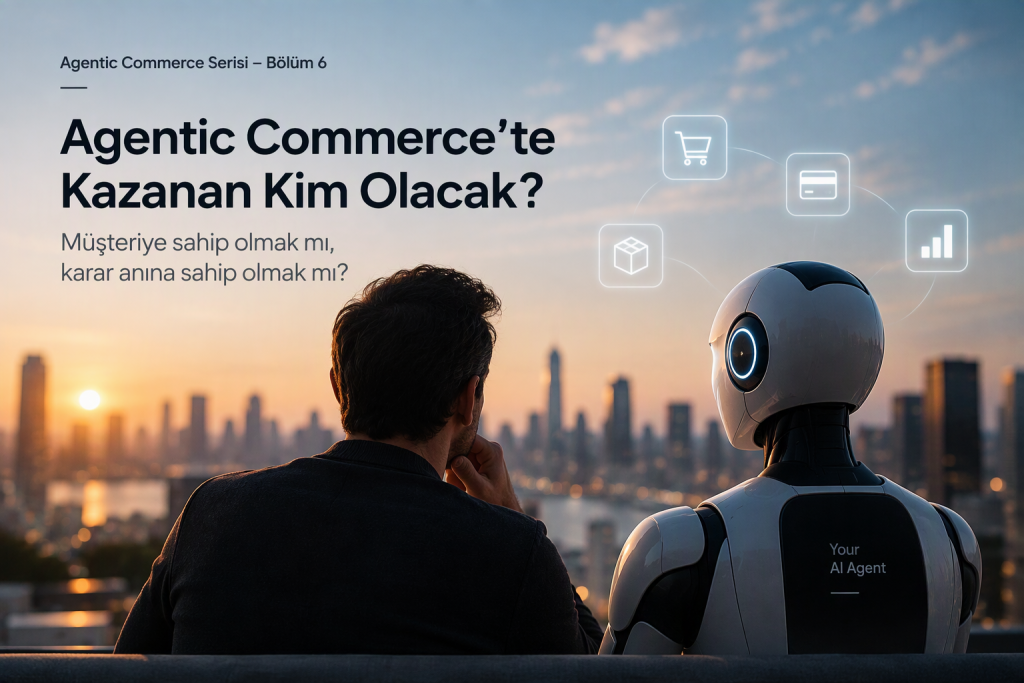
Owning the customer was a major advantage for many years. But when an agent that decides on the customer's behalf steps into the picture, who will hold the real power?
In this series we've discussed that the next customer on the internet might not be human. We looked at how the search economy might change, who will hold decision-making authority and payment, and how brand loyalty might be reshaped.
At the end of all this, a bigger question remains in my mind:
If Agentic Commerce becomes widespread, who will hold the power in this new commercial order?
Today the answer looks relatively clear. Companies that control the customer relationship, own the data, sit close to the moment of payment, or have a strong distribution channel start out with a significant advantage.
But when a new structure steps between the customer and commerce — one that researches, compares, decides, and perhaps even pays on their behalf — this balance can shift. Reaching the customer and standing at the point that shapes the customer's decision may no longer be the same thing.
Is Owning the Customer Still Enough?
In finance and technology, the customer relationship has long been one of the most valuable assets. Banks sit at the center of the customer's financial life, card schemes and payment institutions sit at the point where the transaction happens. Digital wallets bring payment instruments together in one place, marketplaces see shopping behavior, and big tech companies touch a large part of the user's digital life.
Agentic Commerce adds a new decision point on top of this structure.
If the user no longer chooses, for every purchase, which seller to go to, which product to review, and which payment instrument to use, owning the customer alone may not be enough.
A bank may manage a customer's account, a platform may sell the product. But if the user's agent doesn't include that bank or platform in its evaluation list, the value of these advantages could diminish.
Could the Agent Become a New Intermediary?
A large part of the internet economy is, in fact, the story of intermediaries. Search engines stepped between the user and information, marketplaces settled between the user and the seller, social media platforms took over a large part of the communication between brand and consumer. Digital wallets created a new link between the user and payment instruments.
Agents could become the new intermediary between the user and commerce.
But there's an important difference that sets the agent apart from previous intermediaries. A search engine shows options, a marketplace puts products side by side, a digital wallet holds payment instruments together. An agent can decide on the user's behalf before any of that even happens.
That's why it falls short to see the agent merely as a new interface. A system that understands the user's intent, evaluates alternatives, and can initiate the transaction could settle into one of the most powerful points in the commerce chain.
Could the player that controls the moment of decision become more powerful than the player that owns the customer itself?
The answer to that will largely depend on how much authority the agent receives from the user.
Where Is the Banks' Advantage?
Banks have an advantage that shouldn't be underestimated: financial relationship and trust.
A bank doesn't just know a customer's payment history. Income flows, spending habits, payment instruments, and the relationship built through financial products form a fairly strong picture of the customer's economic life.
In a world where payment authority is at stake, this relationship could become even more important. A user might easily allow an agent to research products, but be far more cautious about giving the same agent access to their account, cards, or other payment instruments.
The power of banks, then, may come not just from holding the money, but from controlling one of the most critical gates to accessing it.
Still, I don't think this alone will be enough. A bank may be close to the customer's money, but if another player reaches the purchase intent earlier, a significant part of the decision process may be completed before the bank even gets involved.
For banks, the question may no longer be just about being present at the moment of payment:
Will they also need to get closer to the moment of decision?
Where Does Open Banking Fit Into This?
Open banking is one of the most concrete examples of this discussion. Under today's structures, users can, under certain conditions, grant third-party service providers access to account information or the authority to initiate payments.
Thinking in terms of agents, a similar authorization logic could be used. For example, a user could grant their agent the right to initiate payments for a limited time, within a certain spending limit, and only in defined categories. The scope of the authority would be explicit, its duration would be set, and the user could revoke it whenever needed.
I think the key distinction that needs to be preserved here is that access and transaction authority are not the same thing.
There's a serious difference between saying "you can see my account" and saying "you can spend money on my behalf." The first grants access to information, while the second leads to a real economic outcome.
For the agent economy to function in a healthy way, these two authorities will need to be clearly separated, and it will need to be possible to later see which authority the user granted and in what scope.
The role of banks could also diverge here. Being the party that verifies the scope of the authority, prevents it from being exceeded, and hands control back to the user when needed could create a new area of value for banks.
Where Could Digital Wallets Fit?
A well-designed digital wallet already connects the user to multiple payment instruments and manages the payment experience from a single point.
In a world where agents start choosing the payment method on the user's behalf, this structure could become even more valuable. Rather than the agent forming a separate relationship with every bank and card, it may be more natural for it to act through the wallet that manages, from a single point, the payment instruments the user has granted access to.
In that case, the wallet turns into part of the authority chain between the agent and the financial system.
But carrying out the transaction and deciding which payment instrument to use are not the same thing. Once that second decision also passes to the wallet, the wallet stops being merely a tool that smooths the payment experience and starts gaining direct power over which payment instrument gets chosen.
Will Marketplaces' Advantage Continue?
Marketplaces' advantage is a bit different. Product, seller, price, stock, delivery information and purchase data accumulated over the years all sit in the same place. A large part of the information an agent would need when choosing a product is already in the hands of marketplaces.
Agentic Commerce could call this advantage into question too. If an agent can simultaneously compare different marketplaces, brands' own sites, and independent sellers, the user's need to stay on a single platform decreases.
Today the user goes to the marketplace and chooses among the options the platform offers. Tomorrow, they may simply describe their need to their agent and let different platforms compete for that same need.
If platforms start trying to reach the user's agent instead of pulling the user to themselves, the balance of power could shift too.
Why Are Big Tech Companies Advantaged?
Companies that are already close to the user's digital life may have a natural advantage in the age of agents. For a good agent to make the right decision, it needs not just product information, but also the user's preferences, habits, and context.
A system that knows where the meeting is, remembers which airline is preferred, and understands which payment instruments it has been granted access to can make far more accurate decisions on the user's behalf.
Once this relationship is established, switching agents may not be as easy as it seems either. Just as data and network effects matter in today's platform economy, the ability to understand the user's context could create a similar advantage in the age of Agentic Commerce.
The other side of this is a concentration of power. If the same platform knows the user, manages the decisions, and has access to the payment process, it could control a significant part of the commerce chain.
So the question is not only which company will build a better agent, but how much power will accumulate in the user's decision process.
Is a New Space Opening Up for Fintechs?
I think it is.
Big platforms may be strong in reaching the customer, but matters like authentication, authorization, payment routing, risk management, and getting different payment instruments to work together won't disappear with Agentic Commerce. On the contrary, as they become invisible to the user, they could become even more critical behind the scenes.
The user may not see most of this. The agent may simply say "payment completed," but behind that single sentence, a large number of financial and technical processes will keep running.
Some of the fintech companies that stand out in the future may not be the ones building apps that people use directly, but the ones providing the infrastructure that lets agents transact safely with financial systems.
We've seen similar shifts before in the payments world. As the user experience got simpler, the infrastructure didn't get simpler too; it often took on a more complex role behind the scenes while becoming invisible to the user.
What Happens If the User Doesn't Remember the Transaction?
One situation I often ran into while reviewing payment complaints was customers not remembering transactions they themselves had made. They would forget a collection, a subscription renewal, or an installment plan and say "I didn't do this." This shows how, even in today's payment world, the gap between a transaction and the user's awareness of it can sometimes widen considerably.
Agents could widen this gap even further. When the user doesn't make the transaction directly, and grants the agent the right to act based on a general authority given earlier, the question "Was this payment really made on my behalf?" becomes far more important.
That's why, in the agent economy, not just the transaction happening, but being able to later understand on what authority, when, and why the transaction was made could become an important competitive factor too.
Where Will the Real Power Concentrate?
Throughout the series we've looked at different points of power. There are players that control search, influence the decision, carry out the payment, and hold the customer relationship. Now a new decision point acting on the user's behalf is being added on top of all of this.
To me, in Agentic Commerce, advantage could form at the intersection of four elements:
User context, decision authority, transaction capability, and trust.
Without user context, the system can't know us well enough; without decision authority, it can't go beyond suggestions; without transaction capability, it can't turn the decision it makes into a real commercial transaction. For all of this to work, the user needs to trust the system, know the limits of the authority they've granted, be able to understand the transactions made, and be able to revoke that authority when needed.
Having just one of these elements can provide a significant advantage. But the player that can bring all four together in the same experience could settle into the most strategic point between the customer and commerce.
That could be a bank, a technology company, a digital wallet, or a marketplace. It's also possible for a new platform, one without a strong consumer brand today, to emerge.
What matters to me isn't the company's name, but which point of the value chain will become strategic.
Up until now, owning the customer relationship has been extremely valuable. In the Agentic Commerce era, a new area of power could be added to that:
The authority to decide on the customer's behalf.
But as the economic value of that authority grows, the responsibility it carries will grow just as much.
Final Word
There's a serious difference between researching on the user's behalf and deciding on the user's behalf. Spending the user's money and determining which brands, products or services even get considered is an even bigger authority than that.
That's why the winner of the Agentic Commerce era may not be the company that makes the most decisions on the user's behalf.
The winner may be the system the user trusts the most to decide on their own behalf.
We started this series with the question "The next customer on the internet might not be human." At the end of six parts, where I've landed is a little different:
The real issue in Agentic Commerce isn't just whether AI can shop on our behalf. The real issue is which decisions, with what authority, and on condition of protecting whose interest, we hand over to these systems.
So the question we've been asking since the start of the series still stands:
Who is deciding in the customer's place, and whose interest is that decision really serving?