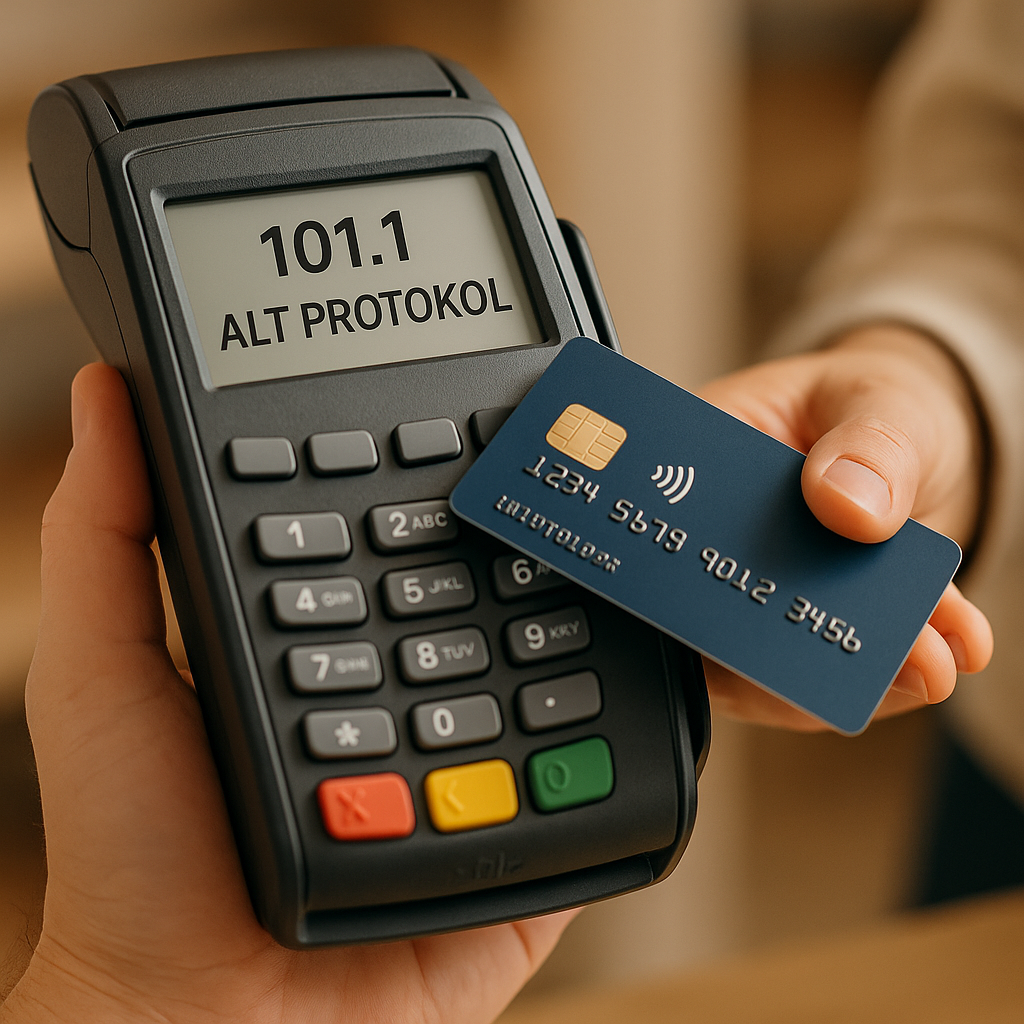
In payment systems, every exchange between POS devices and bank or payment institution systems takes place over a specific messaging standard. This structure is generally based on the ISO 8583 standard. However, each country, bank, or switch network uses a version of this standard defined according to its own needs. These versions are called sub-protocols.
The most widely used POS protocol family in Turkey is the "101.x" family. Over time, this structure has evolved into sub-versions such as "101.1" and "102.1", and has come to support newer transaction types such as EMV, QR, FAST, and Visa Direct.
What Is a Sub-Protocol?
A sub-protocol defines which messaging rules and field structures a POS device uses to send transactions to the bank's system.
For example:
- The 101.1 protocol uses the classic ISO 8583 message format,
- 102.1 can additionally support QR codes, campaigns, or extra fields.
Each sub-protocol defines its own specific sets of data elements, PIN block formats, MAC verification methods, and error codes.
Commonly Used POS Sub-Protocols in Turkey
| Protocol | Scope / Use Case | User Institutions | Features and Supported Transactions |
|---|---|---|---|
| 101 / 101.1 | Classic POS (magnetic, chip, contactless) | Ziraat, Vakif, Halk, Kuveyt Turk, many private banks | Based on the ISO 8583:1987 standard. EMV-supported. Field 55, 60, 61, 62 active. Sale, cancellation, refund, and batch close transactions. |
| 102 / 102.1 | Next-generation POS (EMV + QR + campaigns) | Private banks, payment institutions | Extended version of 101.1. Carries campaign or loyalty information via Field 63. Supports QR code transactions. |
| 103 / 103.1 | Mobile POS / SoftPOS | Fintech companies (Finagotech, iyzico, Paratika, etc.) | Mobile device based. Accepts only online transactions. EMVCo L3 compliant. Supports HCE tokenization and digital cards. |
| 201 / 201.1 | E-commerce (virtual POS) | Banks, virtual POS gateways | Includes 3D Secure (MPI) integration. Carries risk and verification data in Field 64, 126. |
| 301 / 301.1 | ATM transactions | Banks, shared ATM networks | Cash withdrawal, balance inquiry, mini statement transactions. Field 22 (Entry Mode), 60 (ATM ID) active. |
| 401 / 401.1 | QR / FAST POS | POS infrastructures connected to the CBRT's FAST system | Compliant with the BKM-FAST standard. Supports TR QR code, C2B transactions, and FAST reference ID. |
| 501 / 501.1 | Visa Direct / Mastercard Send | International money transfer infrastructures | Cross-border remittance, send/receive transactions. Contains special fields such as Field 125, 127.22. |
| 701 / 701.1 | Loyalty / campaign POS | Loyalty points and campaign POS infrastructure | Carries campaign ID, points balance, or promo code in Field 63. Sent in parallel with sale transactions. |
Features of the 101.1 Protocol
"101.1" is the most widely used POS-to-host communication protocol in Turkey.
It has the following features:
- Based on the ISO 8583 (1987) standard.
- Supports EMV and magnetic card transactions.
- Field 55 (EMV Data), Field 60 (Terminal Data), and Field 62 (POS Parameters) are actively used.
- MAC (Message Authentication Code) calculation is mandatory.
- Covers all classic POS messages such as batch close, reversal, refund, and completion.
This structure ensures interoperability between banks and is also supported at BKM's switch layer.
What Does the ".1" Suffix Mean?
A protocol number ending in ".1" indicates that it is an enhanced or extended version of the same standard.
These sub-versions generally include:
- Additional fields (e.g., Field 63/125),
- QR or campaign support,
- Token or contactless transaction parameters.
In other words, "101.1" is the version of protocol 101 extended with EMV and additional fields.
Future Directions
POS messaging infrastructure in Turkey is rapidly becoming API-based and open banking compliant.
In the coming period, structures such as:
- 401.x (FAST protocols)
- 501.x (Visa Direct / Mastercard Send)
- 601.x (Open Banking / API POS)
are expected to become increasingly widespread.
This is also leading to the rise of ISO 20022 and JSON-based message sets alongside classic ISO 8583.
Conclusion
POS sub-protocols are the invisible but critical infrastructure components of payment systems.
Knowing which protocol a POS device operates on is vital for understanding the transaction types it supports, its integration requirements, and its error-handling logic.
Although 101.1 remains the most widely used version in Turkey, the fintech ecosystem is rapidly evolving toward the 401 and 501 protocols. This transformation is making the infrastructure more flexible and faster, both for next-generation digital wallet and FAST transactions and for international money transfers.