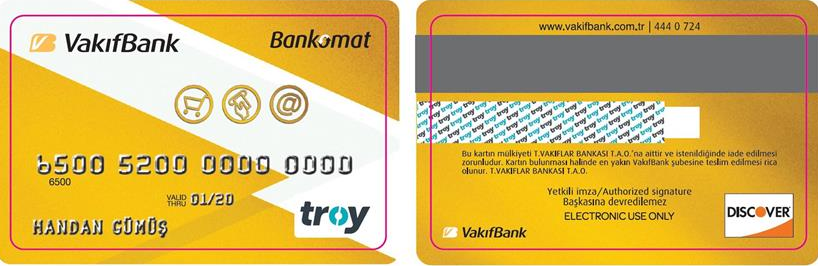
A co-badge card is a card issued under two or more payment schemes (Mastercard, Troy, Diners Club, Discover, etc.) at the same time.
If a card-issuing bank has a product that supports two or more payment schemes, its customers must request that their card carry two or more payment brands.
For a transaction made with such a card, the set of operations the card can perform depends on which payment scheme is active at the time of the transaction.
Payment scheme pairings differ between debit and credit cards.
- For debit cards – for example, Troy, Visa Electron, Maestro, Discover;
- For credit cards – for example, Visa, MasterCard, American Express, Troy
Are there co-badge cards in Turkey?
Co-badge cards generally come into play when one payment scheme cannot be used abroad, or when a card belonging to a foreign card scheme cannot be used at domestic POS terminals and ATMs.
In Turkey, Alternatif Bank was the first to issue a co-badge card, by adding the TROY logo onto its existing Diners Club Cards. Thanks to this card, Alternatif Bank's Diners Club Cards began working over the Diners network at the POS terminals of banks that acquire for Diners, and over the TROY network via BKM at the POS terminals of all other banks that acquire TROY-branded cards. The Diners-Troy co-badge card made it possible for all of Alternatif Bank's cards to be used throughout Turkey.
In a similar vein, an agreement with Discover made it possible for cards under the Troy scheme to be used abroad: Troy-branded cards can now transact without issue at POS terminals and ATMs abroad that support Discover-branded cards.
Are there other uses for co-badge cards?
Yes, there are. Combo cards are another example of co-badge cards. Combo cards combine both credit card and debit card functionality. In other words, combo cards are issued under both the debit payment scheme and the credit card payment scheme. For example, in the case of Mastercard, the debit function is created under the Maestro scheme, while the credit card function is created under the Mastercard scheme.
On a co-badge card, which logo is printed where?
Generally, the payment scheme used domestically is printed on the bottom right of the front of the card, while the other, partner payment scheme is printed on the back of the card. There are also cases where both payment schemes are printed on the front of the card. There is not yet a clear standard on this.
Can a POS terminal or ATM accept more than one payment brand?
Yes, it can.
- When a POS terminal accepts only one payment scheme, cardholders cannot choose which payment scheme to pay with; they can only use whichever scheme is present on both the card and the terminal.
- When a POS terminal accepts more than one payment scheme associated with the card, the user is asked which payment scheme they want to transact with. For transactions made at a POS terminal, the terminal displays the available payment schemes, and the bank's customers can select the one they want to use for that payment.
- When a transaction is made at a POS terminal or ATM with a card that has two or more functions (a combo card), the customer is asked whether they want to transact with the debit card or the credit card. If the customer wants to use the debit card, the transaction proceeds via the Visa Electron or Maestro payment scheme; if they want to use the credit card, it proceeds via the Visa or MasterCard payment scheme.
For cards with a single function (debit, prepaid, or credit card), selecting a specific payment brand does not change the card's function.