Cryptocurrencies, which have recently been used in many fields, continue to become a bigger part of our lives. They are expected to become a serious competitor to card payments in particular.
So what are the terms used in the cryptocurrency world? Let's take a quick look:
Address: The name given to a string of alphanumeric characters used to send or receive cryptocurrency.
Accumulation: Price moving sideways for a certain period of time; consolidation.
Altcoin: The name given to all cryptocurrencies that emerged as alternatives to Bitcoin.
Arbitrage: Buying and selling in order to profit from price differences between cryptocurrencies on different exchanges.
ASIC (Application-specific integrated circuit): An electronic chip built solely for mining. It is faster and cheaper than the processors used for mining.
ASIC Miner: Unlike hardware such as processors or graphics cards used in mining, this is a device built solely for cryptocurrency mining. It uses ASIC chips and offers low power consumption and fast production capacity.
Ask Price or Lowest Ask: It sits at the top of the sell table. It is the lowest price set for selling. If a sell order with a lower price arrives, it moves to the first position in the table. The asset's ask price also changes according to this data.
ATH (All time high): The highest point a cryptocurrency price has reached; its own record.
Bear, Bearish: A price that is inclined to fall.
Bid Price or Highest Bid: It sits at the top of the buy table. It is the highest price set for buying. If a higher buy order arrives, it moves to the first position in the table. The asset's bid price also changes according to this data.
Bitcoin: The first decentralized, open-source cryptocurrency. Its abbreviation is BTC and its symbol is ฿. Many cryptocurrencies on the market trade against the BTC pair.
Block: The data packets that carry transaction and confirmation data on a blockchain are called blocks. Today, blockchains other than the Bitcoin chain have also started to be used.
Blockchain: The ledger of a given cryptocurrency, a kind of accounting book in which all of its transactions are kept.
Block Explorer: The name given to websites that make it possible to follow all transactions taking place on a blockchain.
Block Reward: The reward given to miners when a block is solved. The block reward may vary depending on the cryptocurrency. For BTC, every time 210,000 blocks are mined, the difficulty level increases and the block reward is halved. Currently, a reward of 12.5 BTC is given for each block.
Breakout: A sharp break of a price that has been squeezed inside a chart pattern.
BTFD (Buy the F*cking Dip): Making a profit by buying a coin whose price has dropped because of a panic at its bottom point.
Bullish, Bull: A price that is inclined to rise.
Cloud Mining: The name given to a type of mining carried out by purchasing processing power from companies that do this work for you, so that you do not have to deal with items such as server hosting and electricity costs. It has lost its former popularity today.
Cold Wallet: Electronic wallets used to store cryptocurrencies offline, without connecting to the internet.
Confirmation: The process in which transactions are confirmed by miners and added to the blockchain successfully and securely. Each cryptocurrency has a different confirmation time and requires a different number of confirmations.
CPU: The name given to a computer's processor. It is used for mining some cryptocurrencies. Because the difficulty level has increased, it is no longer preferred for BTC.
Cryptocurrency: A unit of cryptocurrency.
Cryptography: An encryption technique used to prevent information from being accessed by unwanted persons. In cryptocurrency transactions, cryptography ensures privacy, security and accuracy.
DDoS: Attacks that cryptocurrency exchanges frequently face. By exhausting the resources of the attacked server, they can cause the service to be blocked.
Decentralized: A term meaning independent and distributed, where control is not managed from a single center.
Deflation: Deflation is the opposite of inflation. It is the situation in which prices keep falling over a certain period of time.
Difficulty: A value showing how long it takes to solve the block encryption of a cryptocurrency. As production increases, the difficulty level also increases.
Digital Signature: The name given to a digital signature that verifies the source of an address in transfer transactions by using public and private keys.
Dip: The lowest price a coin has reached within a certain time interval.
Double Spending: A problem that arises when the cryptocurrency used in a spending transaction is spent twice. Although it is very rare, it has still not been prevented one hundred percent.
Dust transaction: Transfers of very small amounts. Because these transactions also take up space on the blockchain and increase the data size, they are considered a problem.
DYOR (Do Your Own Research): Means "do your own research."
Exchange: Centralized exchange platforms where cryptocurrencies are bought and sold.
Faucet: Services used for advertising and promotion that give very small amounts of cryptocurrency in return.
FOMO (Fear of missing out): The fear of missing out that is felt while a cryptocurrency price is rising.
Fork: The situation that arises when an improvement is made to a blockchain's source code and this development is continued along two different branches. After this split, the transactions start producing different blocks. Bitcoin and Bitcoin Cash are an example.
Pattern: Price data taking on certain shapes, such as pennants, flags, wedges and so on.
FUD (Fear uncertainty and doubt): The feeling that prices in the market will fall, or a person's state of unease.
Full Node: A node that holds a copy of the entire blockchain and can perform verification without needing another node. It is generally needed in order to be able to mine.
Fundamental Analysis (FA): Research carried out to understand what the market value is, taking into account all data, such as political, economic and social data.
Genesis Block: The block of the first Bitcoin on the blockchain, found by Satoshi Nakamoto.
GPU: The graphics processing unit, in other words the graphics card of a computer. Because it is faster than computer processors, it is widely used in cryptocurrency mining.
Halving: The situation in which Bitcoin's block reward is cut in half every 210,000 blocks (approximately every 4 years).
Hash : A cryptographic method that makes it possible to encrypt a text and obtain a different value of a different length.
Hashrate: The rate used to express the number of operations that can be solved within a certain period of time while mining.
HODL (Holding On for Dear Life): Waiting without selling while a coin's price is falling, holding on to it with the future in mind.
Hype: The situation in which prices are pushed above their likely levels, or inflated, by news or rumors.
ICO (Initial Coin Offering): A crowdfunding method in which a company launches its own cryptocurrency on the market in order to raise funds. Generally, the company releases a certain amount of cryptocurrency to the market and tries to bring its projects to life with the revenue obtained from these tokens.
IPO (Initial Public Offering): It has a structure very similar to an ICO, but the difference between them is that the ownership of the shares offered to the market during an IPO always belongs to the company that issued them.
Inflation: Inflation is the situation in which prices keep rising over a certain period of time.
Input : The address showing where a transfer comes from.
Liquidity: Purchasing power in trade-related transactions; liquidity.
Lightning Network: A network system that increases speed and reduces cost by sending all payments to be made to the same address within a single transaction.
Market Order: An instruction that, when buying or selling in cryptocurrency trading, executes at the current value of the market price with no forward-dated order. More transaction fees are generally charged on these orders.
mBTC: One thousandth of a bitcoin (0.001 BTC).
Microtransaction: Making a very small payment in return for a service requires deductions such as transaction fees and commissions, so existing payment systems such as credit cards cannot be used. The name given to such transactions being carried out with cryptocurrency payments.
Miner: The name given to people or programs that produce cryptocurrency.
Mining: The process of solving encrypted blocks and producing cryptocurrency by using electronic hardware.
Mining Rig: Hardware formed by bringing multiple units together in order to mine.
Mixing Service: A service that protects privacy during transfers by mixing transactions with other transactions to create new inputs and outputs.
Moad: A massive drop.
Node: The name given to the nodes that make up the blockchain network.
Nonce: The number required to obtain the target hash value during mining.
Opcode: In a transfer transaction, the part of the command in the recipient's transaction block that specifies the operation to be performed.
Orphan Block: The name given to invalid block fragments on the blockchain.
Output: The address showing where a transfer will go.
P2P: The person-to-person transfer protocol and distributed network architecture that forms the foundation of the blockchain.
Paper Wallet: A cold wallet method used to store cryptocurrencies securely, without being connected to any digital medium or computer.
Pool: Miners coming together and combining their processing power because of the increased difficulty of mining. The reward for a block that is found is shared among the partners in the pool according to their processing power.
Pre-mining: A portion of the currency being mined by the cryptocurrency's founder before the cryptocurrency is released to the market.
Private Key: The secret numeric key, unique to you, that is needed to be able to use the cryptocurrency in your wallet. It must never be shared openly.
Proof of Stake (POS): The block production and validity confirmation mechanism is tied to the stake that the machine producing the block holds on the relevant blockchain network. In the PoS algorithm, nobody competes with each other as they do in PoW. Miners are replaced by "validators". Validators create the new block to be added to the blockchain and include transactions in it. In this way, the transfers are added to the blockchain and completed. Simply put, validators are those who hold the cryptocurrency. The more you hold, the higher your chance of being selected as a validator for the next block. In addition, the block reward given to whoever finds the new block does not exist in the PoS system; only the fees of the transactions it includes are collected. The basic concept is fairer than PoW, and if a validator tampers with transactions, all of the coins held in its stake are confiscated as a penalty. In short, all you need to do in PoS is hold your coins and leave your computer on. The more you stake, the higher the chance that your computer, that is, your node, will process the transaction. PoS will also eliminate the hierarchy of mining pools caused by PoW and the threat to Bitcoin's decentralized nature. Since it does not consume as much energy as PoW, it is also more environmentally friendly.
Proof of work (POW): A system in which computing power depends on mining capacity. To find a digest with certain properties defined in advance, miners check every possible input by trial and error. The first miner to find the desired digest earns the right to produce the new block on the blockchain, confirms the transaction, and is rewarded in return for the work. Because the result of the digest function is random, every miner has a chance of receiving the reward. Whoever tests faster will have a higher chance of winning the reward.
Public Key: The public address of the wallets used to receive, send and store cryptocurrency.
Public Key Encryption: A two-key encryption system in which one key's job is to encrypt and the other's is to decrypt.
Pump and Dump: A group of stock market investors agreeing among themselves and manipulating the market to push the price down or up at a specific time.
REKT (Wreck — Wrecked): Going bust; used to describe people who have suffered large losses on a cryptocurrency exchange.
Resistance: The resistance point where buying turns into selling.
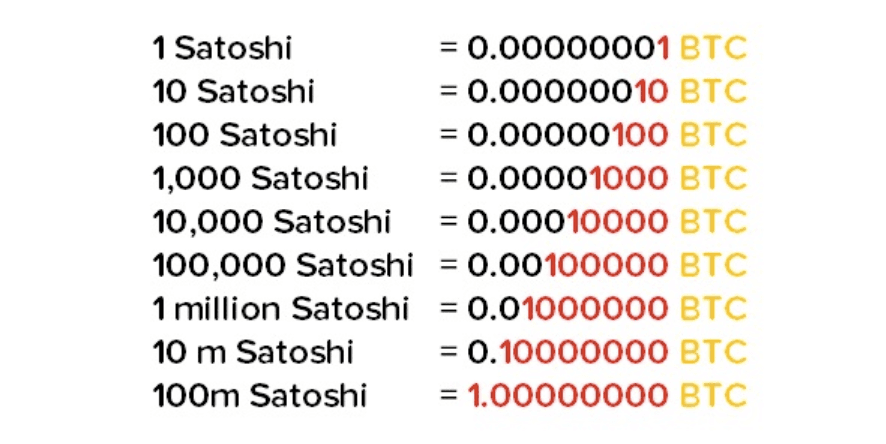
Satoshi: One hundred-millionth of a Bitcoin (0.00000001 BTC). It is also referred to as sats.
Satoshi Nakamoto: The pseudonym used by the person or people who created Bitcoin.
Scalp: A gain obtained in a short time through a sudden sale during a decline.
Scamcoin: An altcoin issued for the purpose of fraud. Scamcoins generally emerge with fake or copied projects, without any underlying idea or purpose, with the intention of collecting the investments of people interested in this field and then withdrawing from the market.
Scrypt: An alternative proof to the SHA-256 working system, designed to give an advantage to those who mine with CPUs and GPUs.
SHA-256: This protocol, used in Bitcoin transactions, is an encryption algorithm designed for use in the digital signature standard. To make the algorithms run fast, the digest of the data is signed rather than the data itself.
Shilling: Giving advice by advertising a coin.
Signature: A digital digest created by combining a private key and a public key in order to prove that transfer transactions come from a certain place.
SPV: A simplified payment verification feature that uses only block headers instead of downloading the entire blockchain.
Stale: The situation in which a block whose solution has already been found is found again by another miner. Miners who produce a stale block do not receive payment for that block.
Stop-Loss: A sell order placed to stop losses, in anticipation that larger declines may occur.