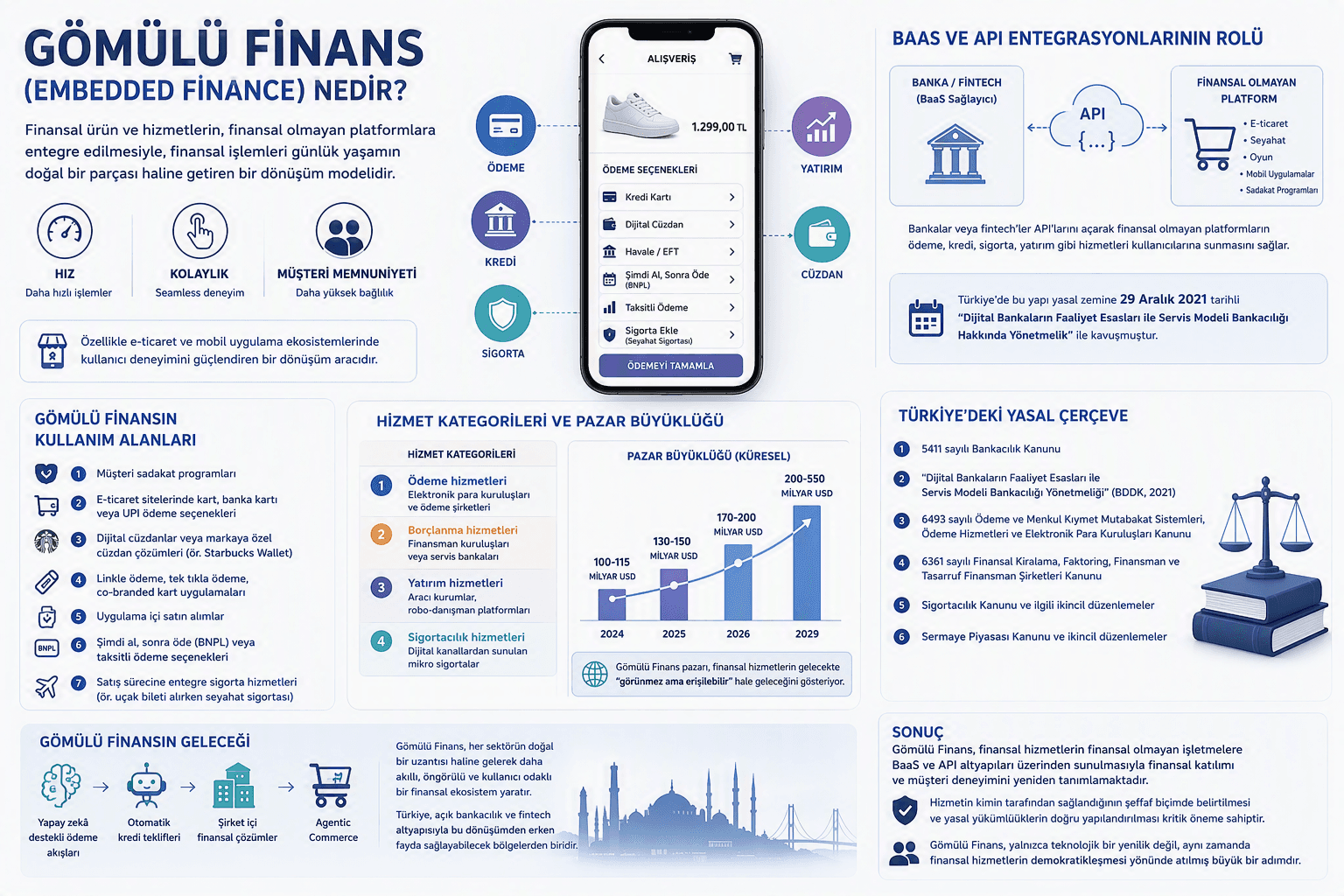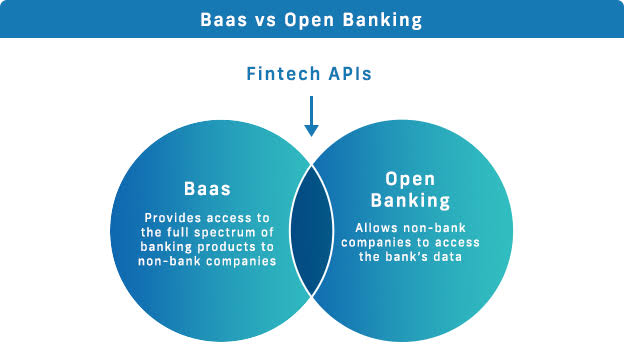
First, it is useful to briefly recall the concepts of Banking as a Service and Open Banking.
Banking as a Service (BaaS) is a banking service model in which interface developers connect directly to service banks' systems through APIs and open banking services, enabling banking transactions to be carried out through the service bank on behalf of their customers, thereby allowing interface developers to bring new products and services to market by using the banking infrastructure owned by the service banks.
Open banking is the sharing of a bank customer's information with third-party companies through APIs, at the customer's request.
In the Draft Regulation on the Operating Principles of Digital Banks and Banking as a Service;
- Banks offering Banking as a Service are referred to as the service bank (BaaS Provider), and third parties are referred to as the "interface developer".
- The environment that enables the use of the bank's infrastructure is referred to as the API (Application Programming Interface).
In global applications abroad, companies such as e-commerce and retail businesses obtain Banking as a Service from banks in order to offer their own customers services such as payment services, fund collection, or customer funding, using the bank's infrastructure.
At this point, Open Banking diverges from Banking as a Service.
In open banking, companies provide services to customers by using their data from multiple banks. Integration with the bank is established solely to access customer data through APIs, without using the bank's infrastructure.
For example, displaying a customer's account transactions across all banks on a single screen, with the customer's consent, can be given as an example of this.
Banking as a Service and Open Banking also differ in terms of how thoroughly they are addressed in the communique:
Although Banking as a Service is addressed in more detail in the draft regulation,
Open Banking is only touched upon very superficially, in Article 41, Section 5, of the Regulation on the Information Systems of Banks and Electronic Banking Services.
While Open Banking is a very important threshold in terms of banks opening up to the outside world, Banking as a Service is highly significant because it goes beyond this threshold, making it possible for banking transactions to be carried out outside of the banks' own platforms.
In conclusion, although Open Banking and Banking as a Service are different concepts, they are of critical importance because they increase Fintech-Bank collaborations through a mutually beneficial model.
It is clear that in both models, the customer will be the winner.
What can we say: "With hopes for an increase in models in which there will be no losers, and in which the Bank, the Fintech, and the Customer will all win."