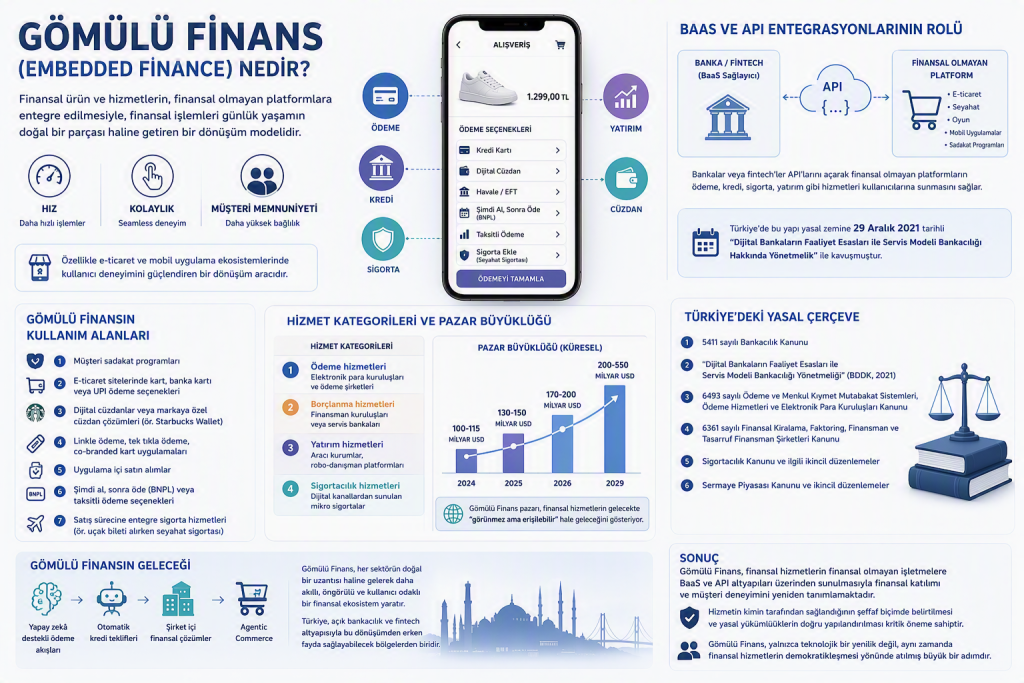
Embedded Finance means integrating financial products and services into non-financial platforms, experiences or business processes.
In other words, it is the inclusion of services offered by financial institutions in the product or service processes of non-financial organizations.
By making financial transactions a natural part of daily life, this model delivers speed, convenience and customer satisfaction. It is a transformation tool that strengthens the user experience, particularly in e-commerce and mobile application ecosystems.
The Role of BaaS and API Integrations
One of the most important building blocks of embedded finance is the BaaS (Banking as a Service) model. In this model, banks or fintech companies open their APIs (Application Programming Interfaces) to non-financial platforms, enabling them to integrate financial services.
This way, a shopping site, a travel app or a gaming platform can offer its users payment, credit, insurance or investment services.
In Turkey, this structure gained its legal footing with the “Regulation on the Operating Principles of Digital Banks and Banking as a Service” dated December 29, 2021. Issued by the BRSA, this regulation clarifies the framework for the BaaS model in our country.
Use Cases of Embedded Finance
Embedded finance sits at the center of digital commerce and the customer experience. Some examples we encounter frequently in daily life are:
- Customer loyalty programs
- Credit card, debit card or Unified Payments Interface (UPI) options on e-commerce sites
- Digital wallets or brand-specific wallet solutions (for example, Starbucks Wallet)
- Pay-by-link, one-click payment and co-branded card applications
- In-app purchases
- Buy now, pay later (BNPL) or installment payment options
- Insurance services integrated into the sales process (for example, travel insurance when buying a plane ticket)
These examples show how embedded finance strengthens customer loyalty by making financial services “in the background but everywhere.”
Service Categories and Market Size
Embedded Finance providers can be grouped under four main headings according to the service they offer:
- Payment services: E-money institutions and payment companies
- Lending services: Financing companies or banking-as-a-service banks
- Investment services: Brokerage firms and robo-advisor platforms
- Insurance services: Micro-insurance offered through digital channels
Globally, according to various research reports, the embedded finance market was around USD 100-115 billion in 2024 and is expected to reach between USD 200-550 billion by 2029.
- 2025: ~USD 130-150 billion
- 2026: ~USD 170-200 billion
This growth is an indication that financial services will become “invisible but accessible” in the future.
The Legal Framework in Turkey
The Embedded Finance business model is supported in the Turkish legal system by the following key regulations:
- Banking Law No. 5411
- “Regulation on the Operating Principles of Digital Banks and Banking as a Service” (BRSA, 2021)
- Law No. 6493 on Payment and Securities Settlement Systems, Payment Services and E-Money Institutions
- Law No. 6361 on Financial Leasing, Factoring, Financing and Savings Financing Companies
- Insurance Law and the related secondary regulations
- Capital Markets Law and secondary regulations
These regulations are important for determining who provides the service, how it is passed on to the customer, and how responsibilities are shared.
The Future of Embedded Finance
By making financial services a natural extension of every sector, Embedded Finance is creating a new financial ecosystem.
In the coming period, it will become much smarter, more predictive and more user-focused by combining with innovations such as AI-powered payment flows, automated credit offers, in-house financial solutions and Agentic Commerce.
Because Turkey is among the countries rapidly developing its open banking and fintech infrastructure, it is seen as one of the regions that can benefit early from this transformation.
Conclusion
By delivering financial services to non-financial businesses through BaaS and API infrastructures, Embedded Finance is redefining financial inclusion and the customer experience.
The most critical element in this ecosystem is transparently stating who provides the service and structuring legal obligations correctly.
Embedded Finance is not just a technological innovation; it is also a major step toward the democratization of financial services.