Digital banking is being talked about more with each passing day, and with the support of the BRSA in defining its scope, it is about to enter our lives.
First, let’s look at what the concept of a ‘Digital Bank’ means.
Credit institutions that provide banking services mainly through electronic banking service distribution channels rather than physical branches have been defined as “digital banks.”
So will digital banking be possible only for branchless banks serving solely through digital channels?
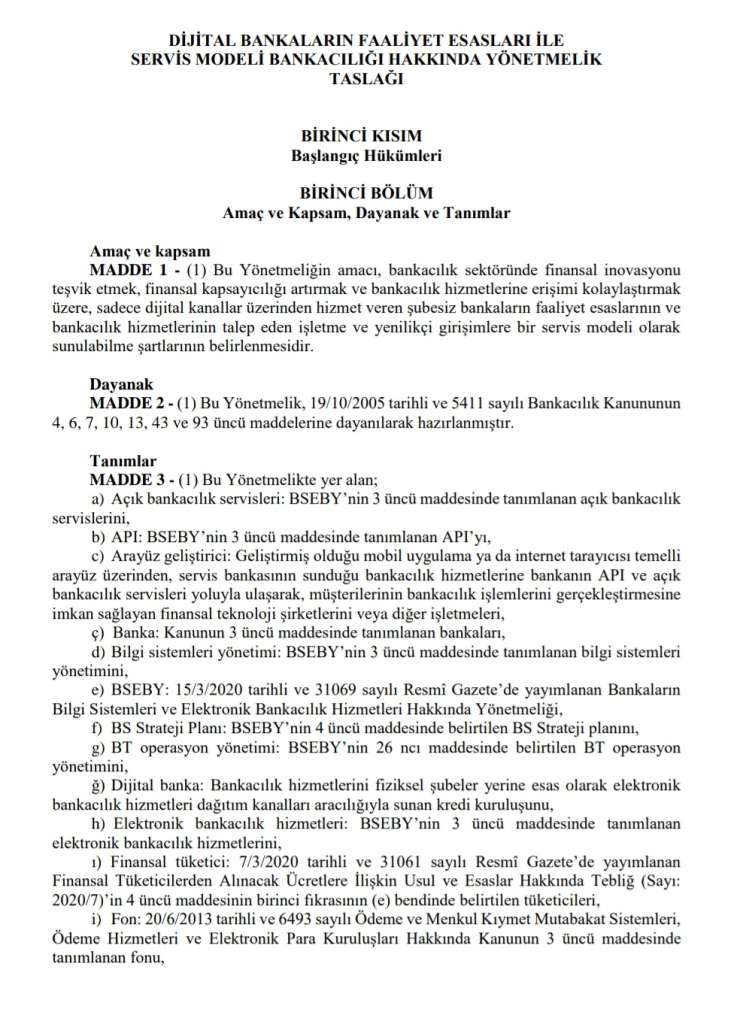
No. The draft regulation sets out the operating principles of branchless banks that serve solely through digital channels, and the conditions under which banking services can be offered as a service model to businesses and innovative start-ups that request them, in order to encourage financial innovation in the banking sector, increase financial inclusion and make access to banking services easier.
Will digital banks be able to carry out all the activities of standard banks?
No. According to the Communiqué, the activity restrictions of digital banks have been set as follows:
- Under this scope, the customers of digital banks may consist only of financial consumers and SMEs.
- Digital banks will not be able to organize beyond the head office and the service units attached to it, and will not be able to open physical branches.
- Digital banks will be required to set up at least one physical office to handle customer complaints.
- Units established to handle customer complaints will not be used as a branch for any other purpose.
- Digital banks will not be able to operate in commercial banking lines of business beyond the SME scale.
- Digital banks will be able to serve their customers through ATM networks they set up themselves or through other existing ATM networks.
- Digital banks will be able to operate in interbank markets or in money and capital markets, accept bank deposits, and extend loans to other banks.
- Digital banks will be able to provide safeguarding account services for payment institutions and e-money institutions licensed under Law No. 6493, and banking-as-a-service (BaaS) services as a service bank for interface developers that do not exceed the SME scale.
- If a customer claims that a transaction was carried out on their account other than by themselves, the bank will bear the burden of proving that the transaction was made by the customer or that the customer was at fault.
- If it is determined that a digital bank endangers both its own risk management capacity and the confidence and stability of financial markets by setting aggressive pricing policies, such as extremely low prices on financing products or extremely high interest rates on deposit products compared with other banks, the digital bank will be obliged to take any measure the Agency deems necessary.
- The total unsecured cash loans that digital banks may extend to a specific customer who is a financial consumer will not exceed 4 times the customer’s average monthly net income.
- If the customer’s average monthly net income cannot be determined, the total unsecured cash loans that may be extended to such customers will not exceed 10 thousand Turkish lira.
- In addition, digital banks will announce, for each distribution channel of the electronic banking services they offer, the committed availability percentage values so that they are visible on the home page of their websites.
- The committed availability percentage for the internet banking and mobile banking distribution channels of digital banks cannot be lower than 99.8 percent.
Is capital required to establish a digital bank?
Yes. According to the Communiqué, the minimum capital required for the establishment of digital banks is one billion Turkish lira, paid in cash and free of any collusion. The Board is authorized to increase this amount.
Will payment institutions and e-money institutions be able to become digital banks?
According to Article 17 of the Communiqué;
- (1) If payment institutions and e-money institutions that have obtained an operating license under Law No. 6493 wish to obtain an operating license as a digital bank, these payment service providers may apply directly for an operating license pursuant to Article 7 of the ITIY and the provisions of this Regulation, provided that they bring their status into compliance with Articles 7, 8 and 18 of the Law, submit to the Agency the documents specified in Article 4 of the ITIY, and fulfill the provisions set out under the second chapter of the second part of this Regulation.
(2) For the payment service providers referred to in the first paragraph to obtain an operating license, they must also bring their status into compliance with the general principles and activity restrictions set out under the first chapter of the second part of this Regulation.
The full text of the relevant draft regulation can be accessed at the link below: