These are credit institutions that provide financing to natural and legal persons for the purchase of any kind of goods and services.
Financing companies are institutions that, with staff specialized exclusively in financing goods and services — vehicle loans being the primary example — differentiate themselves from banks and other financial institutions by producing fast and flexible solutions for their customers at the point of sale and simultaneously with the sale.
For Financing Institutions to be able to extend credit, they must hold an operating license granted by the Banking Regulation and Supervision Agency (BRSA) under Article 4 of Law No. 6361. The BRSA grants operating licenses only to companies that meet the incorporation requirements set out in Articles 5 and 6 of Law No. 6361.
- How Do the Lending Systems of Financing Companies Work?
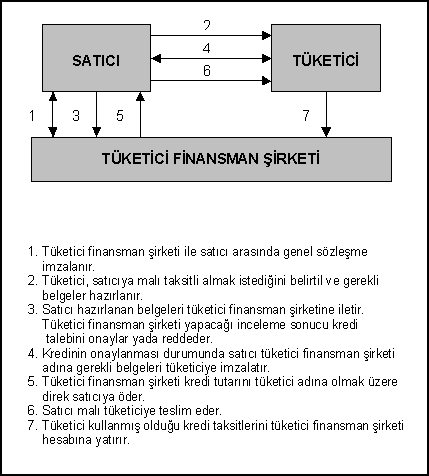
To provide need-based funding, financing companies set up a tripartite system among the Seller, the Financing Company, and the Buyer. The cash flow among the actors in this relationship differs from the cash flow provided in bank loans;
- Credit extended by Financing Companies must first and foremost be provided for the acquisition of a good or service. Financing Companies must conduct their operations within a system built around funding a good or service.
- Companies or natural persons cannot receive cash directly. For example, when a company’s bank loan application is approved, the money is transferred directly from the Bank to the applicant, whereas with Financing Companies, the financing company transfers the money on the Buyer’s behalf directly to the goods and services provider (the seller); credit is opened in the name of the buyer of the goods and services, and the Buyer makes payments to the financing company according to the payment plan. In other words, the Buyer becomes indebted to the financing company rather than to the Seller; the Seller receives the price of the service from the Financing Company immediately and provides the service directly to the buyer. (Figure 1)
2- Establishment of the Legal Relationship Between Financing Companies and Sellers
Pursuant to Article 39/2 of Law No. 6361, which provides that “Financing companies are required to enter into a prior, general written agreement with the sellers who supply the goods or services to be financed,” Sellers are obliged to enter into a prior agreement with the Financing Companies that will provide financing services to their Customers or Suppliers.
The Financing Agreement; under Article 39/1: “A financing agreement is an agreement that provides for the financing of the purchase of any kind of goods or services, in the name and on behalf of the natural or legal person purchasing the goods or services, through direct payment to the seller upon the delivery or supply of the goods or services. Loan repayments are made to the financing companies by those in whose name the credit was opened.”
The financing agreement must be executed in writing, or remotely through the use of distance communication tools, or — whether remote or not — through an information or electronic communication device that the Board has determined may substitute for the written form, and it must be drawn up in a manner established through methods that allow the customer’s identity to be verified at the time the financing agreement is signed.
3- Establishment of the Legal Relationship Between Financing Companies and the Buyer
The relationship between Financing Companies and their credit customers differs depending on whether the Buyers are Commercial Credit Buyers or Consumers.
Consumer Financing
In cases where the buyer of the goods and services is a consumer — that is, a natural or legal person acting for purposes that are not commercial or professional — the provisions of Law No. 6502 on the Protection of Consumers (“Law No. 6502”) apply;
- Pursuant to Article 22 of Law No. 6502, a written “Consumer credit agreement” must be made between Financing Companies and the consumer who will use the financing loan. Consumer Credit refers to an agreement whereby the lender extends, or undertakes to extend, credit to the consumer in exchange for interest or a similar benefit, through deferred payment, a loan, or similar forms of financing.
- Pursuant to Article 23 of Law No. 6502, providing prior information to Consumers before the agreement is mandatory.
- Pursuant to Article 24/1 of Law No. 6502, Consumers have a right of withdrawal. “The consumer has the right to withdraw from the consumer credit agreement within fourteen days, without giving any reason and without paying a penalty.”
- The agreements that Financing Companies make with their credit customers qualify as “Linked Credit” under Article 30 of Law No. 6502. Therefore, pursuant to Article 30/3, the right of withdrawal can be exercised by the credit customer against both the seller and the financing company. If the right of withdrawal is also exercised against the lender, the linked credit agreement terminates as well, without any obligation to pay compensation or a penalty. Pursuant to Article 30/4, if the goods or services sold are defective and are not delivered or performed at all, or not performed properly in accordance with the return provisions, the seller, the supplier, and the lender are jointly and severally liable if the consumer exercises the right to withdraw from the sales agreement or to a price reduction.
- Pursuant to Article 24/2 of Law No. 6502, the lender is required to prove that the consumer was informed of the right of withdrawal. It is sufficient that notice of the exercise of the right of withdrawal is sent to the lender within the withdrawal period.
- Financing Companies may determine the main items and descriptions of the fees, commissions, and charges that can be collected from their Consumer Credit customers in accordance with the “Prospectus on Products and Services That May Be Charged Under the Regulation on the Procedures and Principles Regarding Fees to Be Charged to Financial Consumers.”
Thanks to Consumer Financing, consumers can obtain the product immediately without needing a bank loan or cash, and can easily repay their debt to financing companies at low interest rates with payment plans of their own choosing.
Supplier Financing
Supplier Financing is generally preferred by commercial businesses to offer payment convenience to the customers to whom they provide goods and services.
Supplier Financing is a financing solution that provides the financing/crediting of the commercial relationship between buyers and their suppliers. Generally, it enables Suppliers to collect, before maturity and through Financing Companies, the receivables arising from a sale previously made to the Buyer company, or it offers their own customers the option of credit payment on the invoice issued at the time of delivery. In this way, the Supplier meets its cash needs by collecting its receivables before or at maturity, while Customers get the opportunity to pay their debts with low interest rates and installment options.
The point in which supplier financing differs from consumer financing is that the Buyer is not a Consumer but a Commercial Business/Tradesperson. In this case, the provisions of Law No. 6502 do not apply to financing agreements made with firms operating on a B2B basis.
You can access the active financing companies operating in Turkey via the following link on the BRSA’s website: