One of the most important transformations in the banking sector over the last few years has undoubtedly been remote customer onboarding. An individual can now become a bank customer within minutes without going to a branch. Thanks to identity verification, video calls and digital contract processes, a problem that had persisted for years has largely been solved.
But there is a striking situation here.
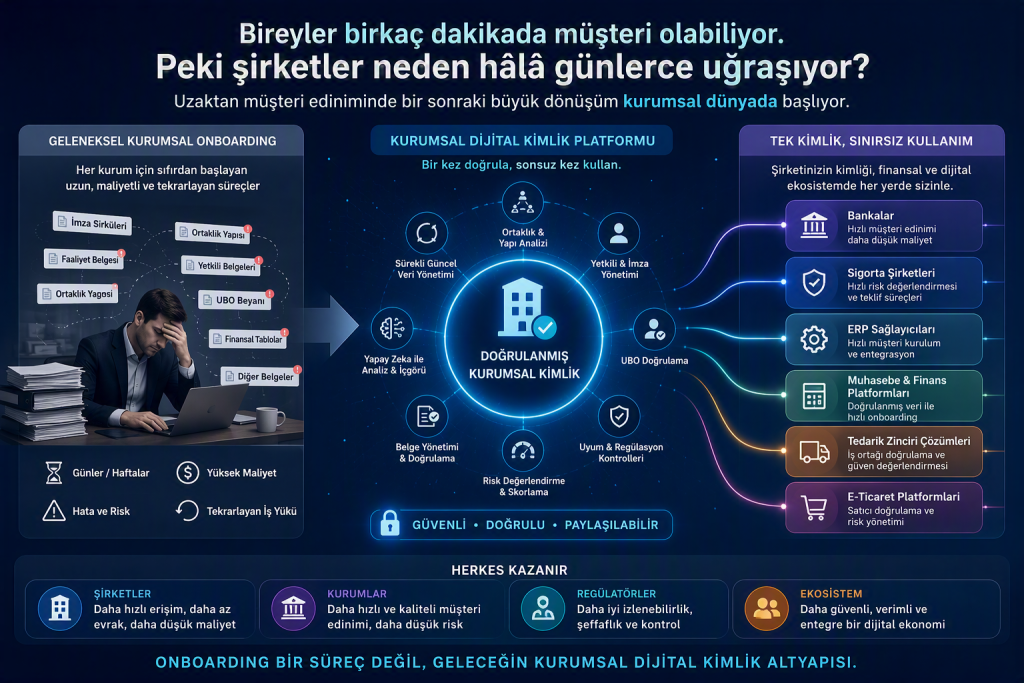
Even though we have come a long way in individual customer onboarding, it is still hard to say that a similar transformation has taken place on the corporate side. When a company decides to work with a new bank, it prepares dozens of documents, defines its authorized signatories, shares its ownership structure, provides ultimate beneficial owner information and goes through compliance and risk assessment processes. Later, when it wants to work with another bank, e-money institution or financial institution, it largely goes through similar processes all over again.
For this reason, when I look at the subject of corporate onboarding, the same question always comes to mind:
Is the problem we are really trying to solve the banks’ customer acquisition process, or the fact that companies have to introduce themselves again and again?
Perhaps we are looking at the issue from the wrong side.
Because today companies have to keep sharing the same information with different institutions in order to operate in the financial ecosystem. Yet in the digital world, we are used to the exact opposite. When we want to log in to an application, we do not create a new account for every platform. We verify our identity once, and then we can use that identity across different platforms.
So why shouldn’t the same approach be possible for companies?
Imagine a company with a verified digital identity. The company’s ownership structure, field of activity, authorized signatories, compliance status and required legal documents are held in a secure digital identity layer. When it wants to apply to a new bank, the process does not start from scratch. The relevant institution can access this information within the scope of the necessary permissions and complete the customer onboarding process much faster.
At this point, corporate onboarding stops being a process and begins to turn into a platform.
Even more interesting is that the value of such a structure is not limited to banks. A verified and continuously updated corporate digital identity can create use cases far beyond the financial sector. An insurance company can use the same information when assessing risk for a new customer. An ERP provider can use a reliable, verified source when setting up a new company in its system instead of collecting the data again. Accounting and financial management platforms can significantly shorten customer verification processes. Companies offering supply chain solutions can assess the reliability and corporate structure of business partners much faster. E-commerce platforms can carry out seller verification and compliance processes at lower cost and with higher accuracy.
Looking at this picture, we see that onboarding is in fact less a banking problem than a trust and identity problem that concerns the entire digital economy.
Artificial intelligence can accelerate this transformation even further.
Today onboarding processes are largely built on collecting and checking documents. Yet new-generation AI systems do not merely read documents; they can interpret, connect and make sense of them. When a company applies, the system can automatically extract the ownership structure, analyze the field of activity, assess sector-based risks, perform compliance checks and even predict the financial products the company may need in the future.
In that case, onboarding is no longer just a customer acceptance process. It turns into an intelligent decision mechanism that enables institutions to understand companies.
Perhaps the real opportunity lies exactly here.
Just as remote customer onboarding changed retail banking, corporate digital identity and onboarding platforms may change the relationship companies have with the financial world in the coming years. In the future, companies may no longer have to explain themselves all over again to every new institution. Instead, they may use their portable, verified and continuously updated digital identities.
Perhaps one of the most valuable fintech companies of the future will not be one that builds a new payment system or launches a new digital bank. Perhaps it will be a platform that manages all of companies’ relationships in the financial world, verifies their identities and provides the trust layer.
Today we call this corporate onboarding.
However, in the next few years, this concept may be replaced by a much bigger idea: Corporate Digital Identity.
And in my opinion, the next big transformation of the fintech world will start exactly here.