White Box Cryptography (WBC) is an important technology used to minimize security risks for open devices such as smartphones.
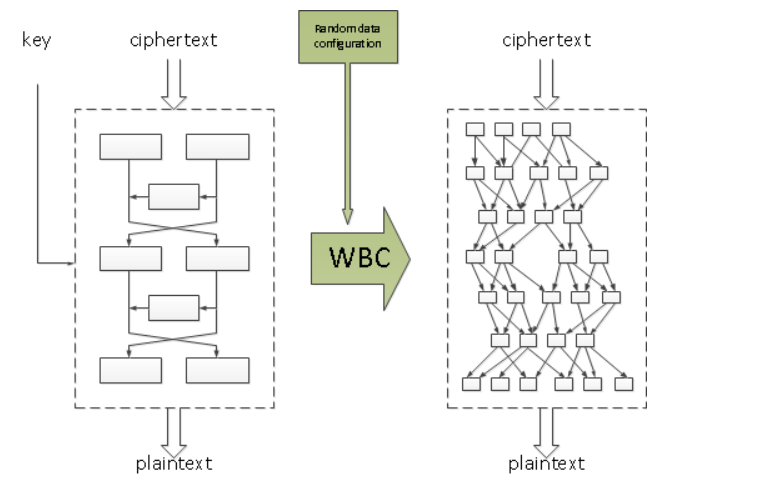
White-box cryptography is a new technique against attacks targeting white-box attack environments. In the white-box attack model, the attacker is even more powerful than in the black-box attack model, and the attacker can observe all intermediate values. For this reason, security algorithms are needed against all exposed processing steps. Secure white-box encryption is used against the white-box attack model with AES and DES implementations.
On open devices, the encryption keys used to make payments can be observed and modified, which makes the devices vulnerable to attacks. White-box encryption prevents secret information such as these keys from being exposed. To achieve this, the keys are not only stored as data and code, but are also concealed through a combination of random data and the code itself.
Attackers can interfere with how an application works by analyzing its binary code and its image in memory. This type of attack is called a “White Box” attack. For this reason, WBC (White Box Cryptography) is an essential approach for the security of applications running on open systems such as smartphones and tablets. With the WBC layer, every type of sensitive information found/used within the software (cryptographic keys, credentials, etc.) is additionally encrypted and stored using a separate cryptographic algorithm.