Skip to content

Search

"card PIN"

164 articles found

Diagram illustrating the card authorization process

Merchant & POS

What Happens During Authorization?

Today, credit cards play an important role in our daily lives. We can carry out almost all of our transactions without carrying cash, using our credit card instead. During a purchase, we hand our card to the cashier and enter our PIN at the POS terminal.


Card skimming device attached to an ATM card reader slot

Fraud

What Is Card Skimming?

Card skimming is the theft of card information by copying it with the help of a device. Because data inside the chip is very difficult to steal, chip cards are far more secure than magnetic-stripe cards. Turkey is very advanced in card security technology.

Illustration representing credit card fraud and online payment security risks

Fraud

What is Fraud? What are the Types of Fraud?

With the growth of credit and debit card usage and rising e-commerce transaction volumes, there has been a serious increase in exploiting user negligence to harm customers. Fraud means using someone else's card at a merchant or ATM to gain unjust profit.

Diagram showing the four pillars of HCE cloud-based security infrastructure

HCE

What is the HCE Cloud-Based Security Infrastructure Like?

The HCE cloud-based security infrastructure consists of four main pillars: Tokenization, Risk Management, Session Keys, and User/Device Authentication. Tokenization indicates the type of token generation, and there are three different tokenization methods.

Contactless payment PIN entry on a POS terminal

Payment Systems

Why Do Some Contactless Payments Require a PIN?

The biggest benefit of contactless payment is completing small transactions quickly. You can pay purchases under 350 TL without a PIN, while purchases above 350 TL require your card PIN.

Illustration representing credit and debit card fraud

Credit Card

Credit Card/Debit Card Fraud

Credit card fraud is generally committed using the card itself, using card details without the card, via excess or duplicate withdrawals, or by seizing identity information. ATM card trapping is common, since ATMs hold the card during the transaction.

Diagram illustrating the SPoC solution architecture for secure PIN entry on a COTS device

Security

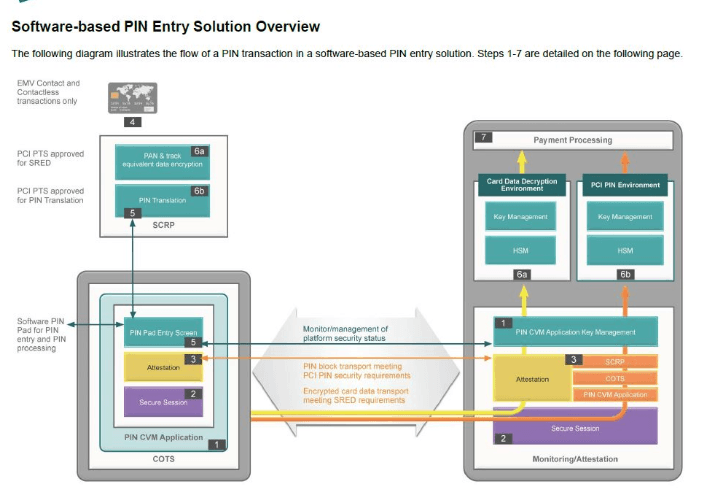
What is Software-based PIN Entry on COTS (SPoC)?

Published by the PCI SSC, Software-based PIN Entry on COTS (SPoC) is a standard that provides a software-based approach for protecting PIN entry on commercial off-the-shelf devices such as smartphones and tablets.

Illustration explaining the concept of the first online transaction after a card PIN change

Merchant & POS

What Does First Online Transaction Mean?

In payment systems, an online transaction means the transaction is sent to the card or POS/ATM bank at the moment it occurs, and required checks are obtained from that system. So does every transaction happen online? Of course not. Especially with contactless...

ISO 8583 field 52 PIN data encrypted PIN block

ISO 8583

ISO 8583 Field Descriptions (F52)

DE 52 — Personal Identification Number (PIN) Data: the field that holds the PIN data. PIN verification is carried out based on this field.

Example of a POS transaction receipt (slip)

Merchant & POS

Don't Dismiss the POS Receipt

In daily credit card purchases, the POS produces two receipts: the Customer Copy and the Merchant Copy. The cardholder gets the customer copy; the merchant keeps its own copy by law.

Illustration representing the PIN Verification Key (PVK) concept in HSM security

Credit Card

What is PVK (Pin Verification Key)?

PVK (Pin Verification Key) is a key held on the HSM, used in PIN generation and verification, and therefore to confirm that a PIN is correct. On a shared network it is encrypted under TMK or ZMK; on a local network it is encrypted under one of the LMK pairs.