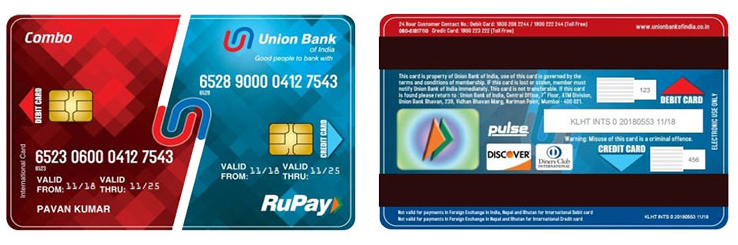
There have been times when we've said, 'I wish banks would make a card that combines both debit and credit card functions, so I could carry out all my transactions with a single card.' Some solutions have been developed in the card world to meet this need. The combo card. A combo card is a card whose chip holds information showing that it supports both a credit card and a debit card, letting the user pick which card they want to transact with and continuing the transaction with that card. Like standard cards, combo cards have only a single chip.
But have you ever seen a card split right down the middle, with one half used as a credit card and the other half as a debit card?
I can almost hear you saying no. When I first heard about it, I thought, 'How does that even work?' and 'There's a printing standard for cards, this would go against those standards' — but forget the standards, the card actually has two chips printed on it. This honestly caught my interest even more, so I did a bit more research into the card's features and details.
Unlike other cards, this card has the following on it;
- Two chips. (Each chip, when read, allows a transaction to be processed as either a credit card or a debit card.)
- Two card numbers. (Under different BIN numbers.)
- Two CVV2 values.
- Two magnetic stripes. (One magnetic stripe belongs to the credit card, the other to the debit card.)
- Two payment schemes. (One is Discover, the other is Diners Club.)
When I think about these features;
- First of all, I wonder what kind of arrangement a manufacturing company — accustomed to producing cards with a single chip at the raw card production stage — made in order to fulfill this request.
- The second question is how the personalization of these cards (printing the customer's information onto the card) could have been done. This is because, under PCI DSS standards, the information in the card printing file is sent in encrypted form. The encrypted file is read and the cards are printed by card printing devices in such a way that no individual can see it. In this case, when these cards are sent for printing, both the credit card and debit card information (the data to be written to the chip, the data to be written to the magnetic stripe, and the data to be printed on the card) must be sent for printing at the same time. This means a change to both the card printing file and the card printing process, which is itself a significant cost.
- The third issue, and the most important one, is how the customer will react to this product. Whether these costs will meet customer expectations in the market, and whether this unconventional card design will have a positive effect on the bank's market share, is something that needs careful attention.
- What action is taken regarding the cards if the customer loses them or has them stolen? The system probably keeps a record that the two cards are linked to each other, so that when one card is closed, the other is automatically closed as well, and the lost/stolen and reissue process starts for both cards. So a single lost/stolen request results in two different card numbers being produced. I won't even get into the shipping address — there's no chance of one half of the card being sent to one address and the other half to a different address :)
- Another issue is changing the card's PIN. Let's say I change my credit card's PIN — will the debit card side change too? Or does the user have to change the debit card PIN manually? It's likely the user will be expected to change it manually. But here's an important detail: on either side, the transaction is approved no matter which PIN is entered. This can be managed in online transactions, but how it's handled in offline transactions is a bit more complicated.
- For purchases made over the internet;
- If you want to transact using the credit card, you need to enter the credit card details,
- and if you want to transact using the debit card, you need to enter the debit card details.
Honestly, there are a lot of intriguing questions about this card, and each one calls for detailed research. But my take on this is that it's a wonderful design in terms of breaking old habits and showcasing our innovative side.
I think it's a design capable of changing how we view cards, and our mental image of credit cards versus debit cards.
I wonder which bank in Turkey will be the first to step outside the standards and change our perspective on cards?
If a card like this were ever issued in Turkey, I would definitely be one of the first customers, and I'm sure I'd enjoy having that kind of experience.
Would you consider using a card like this?



