An important regulation that directly concerns credit card users came into force recently.
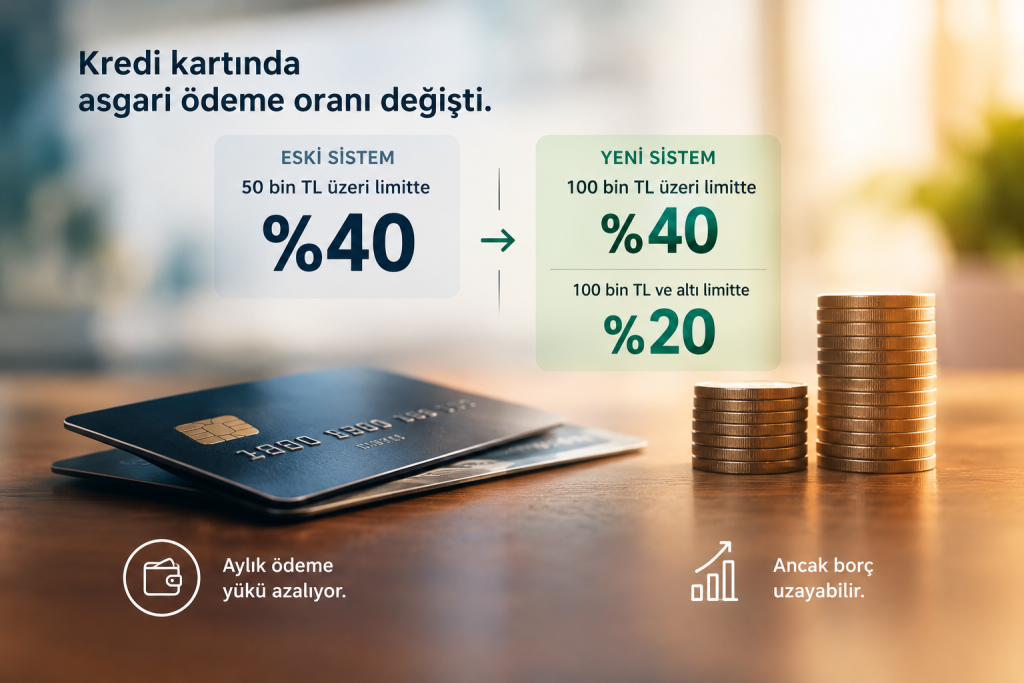
The BRSA raised the limit threshold used in determining the minimum payment rate on credit cards from TRY 50,000 to TRY 100,000.Under the new rule, 20% of the statement balance will apply as the minimum payment for cards with a limit of TRY 100,000 or below, and 40% for cards with a limit above TRY 100,000.
Although it may look like a technical regulation at first glance, this is actually a decision that can affect the monthly cash flow of millions of people.
So why was this change made, and what might it lead to?
What Actually Changed?
Under the previously applied system, users with a credit card limit above TRY 50,000 had to pay at least 40% of their statement balance.
With the new regulation, this threshold has been raised to TRY 100,000. As a result, cards with a limit between TRY 50,000 and TRY 100,000 have been moved out of the 40% group and into the 20% group.
For example:
- Card limit: TRY 80,000
- Statement balance: TRY 50,000
Old system:
- Minimum payment: TRY 20,000
New system:
- Minimum payment: TRY 10,000
For the same debt, the minimum amount that comes out of the customer’s pocket has been halved.
Why Did the Regulation Come Now?
We need to look at the bigger picture here.
Over the last two years, credit cards in Turkey have gone beyond being merely a payment instrument.
For many consumers, they have become:
- A cash flow management tool,
- A source of short-term financing,
- A way to protect purchasing power against inflation
That is what they have become.
During periods of high inflation, citizens’ spending has risen faster than their income growth, and credit card usage has reached record levels.
For this reason, regulators are trying to control credit growth on the one hand, while taking steps to protect individuals’ ability to pay on the other.
This decision seems to be largely the result of that search for balance.
Will It Relieve Citizens?
In the short term, yes.
In particular, the monthly payment burden of cardholders with a limit between TRY 50,000 and TRY 100,000 will fall noticeably.
For someone struggling to make it to the end of the month, the minimum payment being TRY 10,000 instead of TRY 20,000 can make a significant difference.
It can prevent the card from falling into delinquency.
It can prevent the bank from applying a limit restriction.
It can provide temporary relief in the number of retail customers falling into non-performing status.
In this respect, the decision has a short-term liquidity-easing effect.
So Where Is the Risk?
The critical point here is this:
The debt is not decreasing. Only the amount that must be paid today is decreasing.
For example, on a card with a statement balance of TRY 50,000:
- Under the old system, at least TRY 20,000 was paid.
- Under the new system, TRY 10,000 will be paid.
The remaining amount will continue to accrue interest and be carried over to the next period.
For this reason, the user may be relieved today, but the time it takes to pay off the debt may get longer.
Especially in periods when interest rates are high, a side effect of such regulations may be growth in the amount of carried-over balances.
A similar situation is seen in many credit card markets around the world:
As the minimum payment rate falls, the monthly payment pressure eases, but the total period of indebtedness gets longer.
What Does It Mean for Banks?
This decision is not an entirely negative development for banks.
Because:
- Late payment rates may fall.
- The number of customers moving into non-performing status may decrease.
- Collection costs may decline.
On the other hand, because more balance stays in the system, a supportive effect on interest income may also emerge.
Therefore, the decision can be considered a regulation aimed at easing the situation for both consumers and the financial system at the same time.
Which Data Will We Need to Watch in the Coming Period?
We will be able to tell whether this regulation is successful in a few months.
The three indicators I will be tracking are as follows:
1. Non-performing credit card receivables
If there is real relief, this ratio should fall.
2. Carried-over credit card balances
If the debt is only being postponed, a rapid increase will be seen here.
3. Share of customers making the minimum payment
If this ratio is rising, it means credit cards are increasingly being used as a financing instrument.
Conclusion
This regulation does not reduce citizens’ debt.
It reduces citizens’ monthly payment burden.
The difference is important.
In the short term, it can create breathing room for millions of people. In the long term, however, it can also cause card debts to remain in the system longer and total interest costs to rise.
So the real question is this:
Will this decision truly relieve citizens, or will it just carry today’s debt over to tomorrow?
The credit card data to be announced in the coming months will give us the answer.