Skip to content

Search

"chip transactions"

105 articles found

Example of a POS transaction receipt (slip)

Merchant & POS

Don't Dismiss the POS Receipt

In daily credit card purchases, the POS produces two receipts: the Customer Copy and the Merchant Copy. The cardholder gets the customer copy; the merchant keeps its own copy by law.

Diagram showing how the iCVV code is generated for EMV chip cards

Credit Card

What Is iCVV? How Is It Generated?

iCVV stands for Integrated Circuit Card Verification Value. To prevent fraud, it is a CVV value generated similarly to the card's track data and stored on the card's chip. Visa uses the term iCVV; MasterCard and American Express use their own equivalents.

Close-up of a bank card's chip failing to be read by a POS terminal

Credit Card

What should I do if my card's chip isn't reading?

If your card's chip won't read, the chip data is likely corrupted or the POS's chip reader is faulty. This is usually caused by magnetic interaction with another card's chip.

ISO 8583 field 35 Track 2 data

ISO 8583

ISO 8583 Field Descriptions (F35)

The card's Track 2 data is carried in this field. Track 2 data contains information such as the card number, expiry date and service code.

Card skimming and copied card details

Credit Card

What Should I Do If My Card Details Are Copied?

Card copying usually happens with magnetic stripe debit cards. As soon as you notice your card details have been copied, you can close the card, renew it or change its PIN.

Diagram showing how offline transactions are relayed from the POS to the card bank

Merchant & POS

How Do Offline Transactions Reach the Card and POS Bank?

In chip transactions made with a credit card via POS, the transaction amount is approved by the card and POS based on parameters on the card and POS, without going to the card bank or POS bank. These are called offline transactions.

Illustration of ISO 8583 message format

ISO 8583

ISO 8583 Field Descriptions (F35)

F35 TRACK-2 DATA: The values printed to the card's Track 2 data in ISO 7813 format, including field separators and start/end sentinels, but excluding LRC (Longitudinal Redundancy Check) characters. It is 37 characters long.

Illustration of a Card Not Present (CNP) online payment transaction

Credit Card

What Is a CNP (Card Not Present) Transaction?

CNP refers to a transaction made through a website or a company's own app payment page, where the card is not read by any device and its details are entered manually. It is short for Card Not Present.

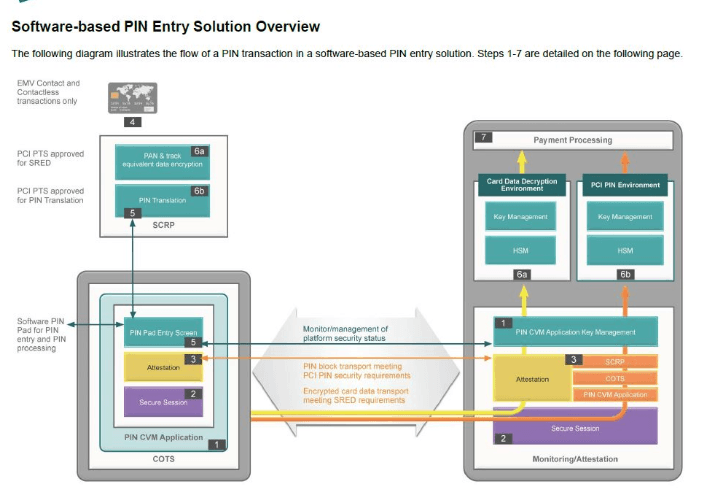
Diagram illustrating the SPoC solution architecture for secure PIN entry on a COTS device

Security

What is Software-based PIN Entry on COTS (SPoC)?

Published by the PCI SSC, Software-based PIN Entry on COTS (SPoC) is a standard that provides a software-based approach for protecting PIN entry on commercial off-the-shelf devices such as smartphones and tablets.

Illustration explaining the concept of the first online transaction after a card PIN change

Merchant & POS

What Does First Online Transaction Mean?

In payment systems, an online transaction means the transaction is sent to the card or POS/ATM bank at the moment it occurs, and required checks are obtained from that system. So does every transaction happen online? Of course not. Especially with contactless...

Table of chargeback reason codes by payment scheme

Chargeback

What Are the Chargeback Reason Codes by Payment Scheme?

A chargeback is the process of requesting that an amount paid by credit card be refunded, either because the goods or services paid for were not received, or because a transaction is identified as one the cardholder did not carry out.