Skip to content

Search

"Message Fields"

66 articles found

Reference table of ISO country codes including two-letter, three-letter, and numeric codes

ISO 8583

ISO Country Codes

In ISO messaging standards, country codes sent in fields such as F43, F19, F20, and F21 must follow a specific standard. Below is the country code list and details used for ISO, including 2-character, 3-character, and numeric codes.

ISO 8583 field 19 acquiring institution country code

ISO 8583

ISO 8583 Field Descriptions (F19)

F19 — Acquiring Institution Country Code: the country to which the location of the acquiring bank's device (ATM, POS, etc.) belongs.

Diagram explaining ISO 8583 field 11 (STAN)

ISO 8583

ISO 8583 Field Descriptions (F11)

DE 11 - SYSTEMS TRACE AUDIT NUMBER: A 6-digit unique numeric value generated by the message originator, enabling unique tracking of the transaction. How is STAN generated?

Diagram showing the structure of the ISO 8583 F54 Additional Amounts field

ISO 8583

ISO 8583 Field Descriptions (F54)

F54 - ADDITIONAL AMOUNTS is the additional amount field used in transactions. It can take different values depending on the transaction, such as carrying account balance information for balance inquiries.

ISO 8583 F90 original data elements field layout diagram

ISO 8583

ISO 8583 Field Descriptions (F90)

F90 - ORIGINAL DATA ELEMENTS: the data elements from an original message, designed to identify the transaction in correction or reversal transactions. Subfields: Original MTI, Original DE 11 (STAN), Original DE 7, Original DE 32, Original DE 33.

Diagram illustrating the structure of ISO 8583 Field 53, PIN Encryption Control Information

Online & Authorization

ISO 8583 Field Descriptions (F53)

F53 - PIN Encryption Control Information. When online PIN data is present, sending the F53 value is mandatory, except when DUKPT information is carried in Field 63, Tag 01. F53 consists of the following components.

Issuer Script Results field values shown on a POS terminal screen

Credit Card

Issuer Script Results

Issuer Script Results is the field that shows the results of the Issuer Script commands sent to the card. This post explains its byte and bit values, what an issuer script is, why the results matter, and what happens when a command fails.

Diagram illustrating the ISO 8583 field 32 structure

ISO 8583

ISO 8583 Field Descriptions (F32)

F32 - ACQUIRING INSTITUTION IDENTIFICATION CODE: the 11-digit acquirer bank ID. The values it can take for domestic transactions and by card brand include Visa, MasterCard, UnionPay, Discover and JCB formats.

Table describing the subfields of ISO 8583 field 60, the advice reason code

ISO 8583

ISO 8583 Field Descriptions (F60)

F60-ADVICE REASON CODE: Used to indicate the specific purpose of an advice/reversal message. It is 60 characters long.

Diagram illustrating the EMV Tag-Length-Value (TLV) data structure used in card transactions

Online & Authorization

What are EMV Tags?

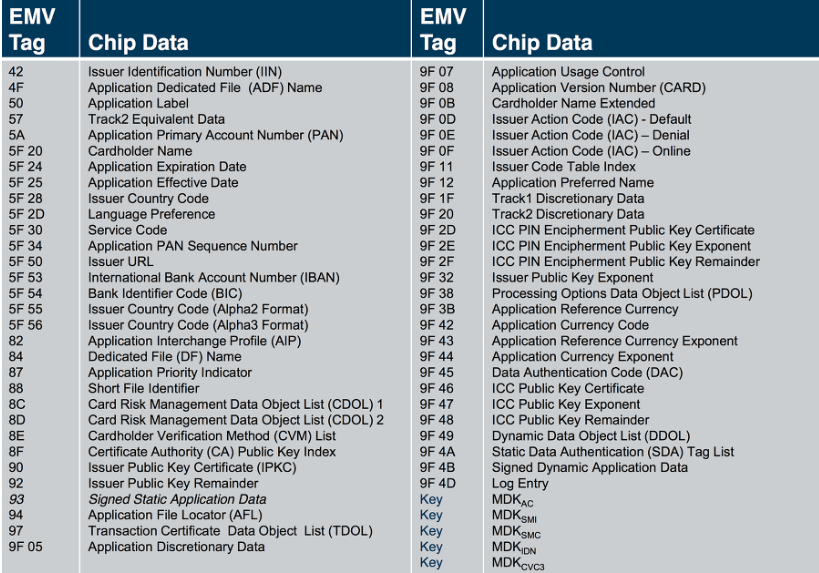
In EMV, data is stored in Tag-Length-Value (TLV) format, and it is carried between the card, the POS terminal, and the authorization system in this same format. This post lists every EMV Tag, its type, and its description.

Diagram illustrating the ISO/IEC 14443 contactless card communication standard

HCE

What Is the ISO/IEC 14443 Standard?

An international standard that defines proximity cards used in Near Field Communication (NFC) and the protocols used to communicate with them. It has 4 parts; Part 4 covers NFC and HCE operations.

Illustration of ISO 8583 message field layout used for field F37

ISO 8583

ISO 8583 Field Descriptions (F37)

F37-RETRIEVAL REFERENCE NUMBER is a code generated by the bank that initiates a transaction, used to uniquely track it. It is a 12-character alphanumeric value.