F90 - ORIGINAL DATA ELEMENTS: These are the data elements from an original message, designed to identify the transaction in correction or reversal transactions.
| Subfield | Description | Attribute |
| 1 | Original MTI, Message Type Identifier | (n-4) |
| 2 | Original DE 11, System Trace Audit Number | (n-6) |
| 3 | Original DE 7, Transmission Date and Time | (n-10) |
| 4 | Original DE 32, Acquiring Institution ID Code | (n-11) |
| 5 | Original DE 33, Forwarding Institution ID Code | (n-11) |
Why is F90 needed?
When a cancellation (reversal) or correction message is sent, the issuer must be able to determine with certainty which original transaction the message refers to. F90 carries together the information that makes up the identity of the original transaction. Using this information, the bank finds the original transaction in its own records and applies the cancellation or correction to it.
How do the subfields enable matching?
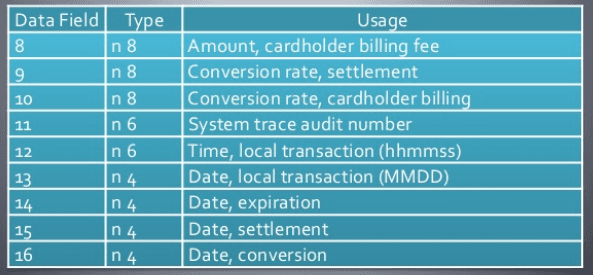
A single field may not be enough to identify a transaction uniquely. For example, the STAN (F11) value wraps around at certain intervals, and different institutions may use the same STAN value. For this reason, F90 uses several pieces of information together:
- The original message type shows whether the transaction is an authorization or a financial transaction.
- The original STAN and transmission date and time make the transaction unique within the sending system.
- The original F32 and F33 values indicate which institution the transaction came from.
When this information is evaluated together, the original transaction can be located with certainty.
Total length
Adding up the lengths of the subfields in the table (4 + 6 + 10 + 11 + 11) shows that F90 is a fixed-length field of 42 characters. Where an institution code is shorter than 11 digits, the value is left-padded with zeros.
If no match is found
If the bank cannot find a transaction matching the F90 information in an incoming reversal message, it may reject the reversal message, or it may assume the original transaction was never approved and respond to the reversal as successful. This behavior varies depending on the rules of the network and the bank.