Skip to content

Search

"Card Expiration"

77 articles found

Photo of a POS terminal related to EMV Issuer Action Code settings

Online & Authorization

Issuer Action Code (IAC)

These are codes that communicate the issuer's conditions for approving a transaction online (IAC-Online), for declining it (IAC-Denial), or for declining it when the terminal cannot go online (IAC-Default).

Diagram illustrating the types of chargeback disputes in card payments

Chargeback

What are the chargeback dispute types?

A chargeback is a dispute raised against a card transaction when the cardholder did not make it or does not recall it. The dispute types vary depending on the situation; let's look at them.

Bank card shown in temporarily blocked status before delivery to the customer

Payment Systems

Why Are Cards Printed as Temporarily Blocked Before Being Sent to the Customer?

Cards are delivered to customers by courier, and at several points along that chain a card could theoretically be intercepted. To prevent misuse before delivery, banks print new and Lost/Stolen replacement cards as Temporarily Blocked, activating them only once the customer receives them.

Illustration representing credit card loyalty points and rewards

Merchant & POS

What are Loyalty Points?

Loyalty points are promotional rewards banks give customers for credit card transactions, tracked on a card/customer basis. Banks charge merchants a commission on POS transactions, and some share part of that commission with cardholders as points.

Table of chargeback reason codes by payment scheme

Chargeback

What Are the Chargeback Reason Codes by Payment Scheme?

A chargeback is the process of requesting that an amount paid by credit card be refunded, either because the goods or services paid for were not received, or because a transaction is identified as one the cardholder did not carry out.

Diagram showing the structure of an ISO 8583 message

ISO 8583

What Fields Make Up ISO 8583?

We covered the ISO 8583 basics in an earlier article. This post explains the ISO 8583 message structure in detail: every ISO 8583 message consists of three main parts - the MTI (Message Type Indicator), the Bitmap, and the Data Elements.

Diagram illustrating the structure of Track3 data on a payment card

Credit Card

What Is Track3?

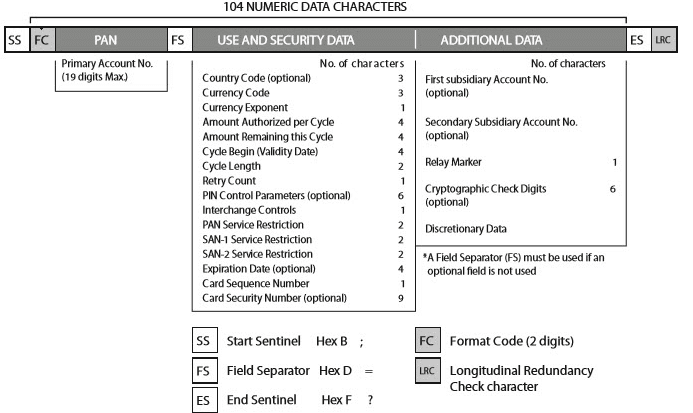
Track3 is a field that doesn't need to be written to the card's magnetic stripe. It's used only in very specific cases and isn't required for authorization transactions. Issuers generally don't encode Track3 data onto the card's magnetic stripe. It consists of 104 numeric characters.

Illustration representing the PA-DSS payment application security standard

HSM & Security

What is PA-DSS (Payment Application Data Security Standard)?

PA-DSS (Payment Application Data Security Standard) is the Payment Application Data Security Standard set by the PCI SSC, a global security standard created by the Payment Card Industry Security Standards Council.

Conceptual illustration of loyalty points versus customer habit in agentic commerce purchasing

Agentic Commerce

Agentic Commerce Series – Part 5

Points or habit? Loyalty programs are built on steering human behavior. But if an AI agent starts shopping on our behalf, do points and campaigns still work the same way?

Diagram illustrating TCR (Transaction Record Component) packets used in payment clearing and settlement files

Payment Systems

What Is TCR (Transaction Record Component)?

TCR stands for Transaction Record Component, the packets that carry transaction information in a clearing system. Transaction types in a clearing file are distinguished by transaction code and usage code values, and this data is sent inside TCR packets.