The credit card minimum payment amount is an important convenience that lets customers who cannot pay their full debt keep using their credit cards.
Is there a specific rule for the credit card minimum payment amount?
Yes, there is. These rules contain certain criteria that all banks must comply with.
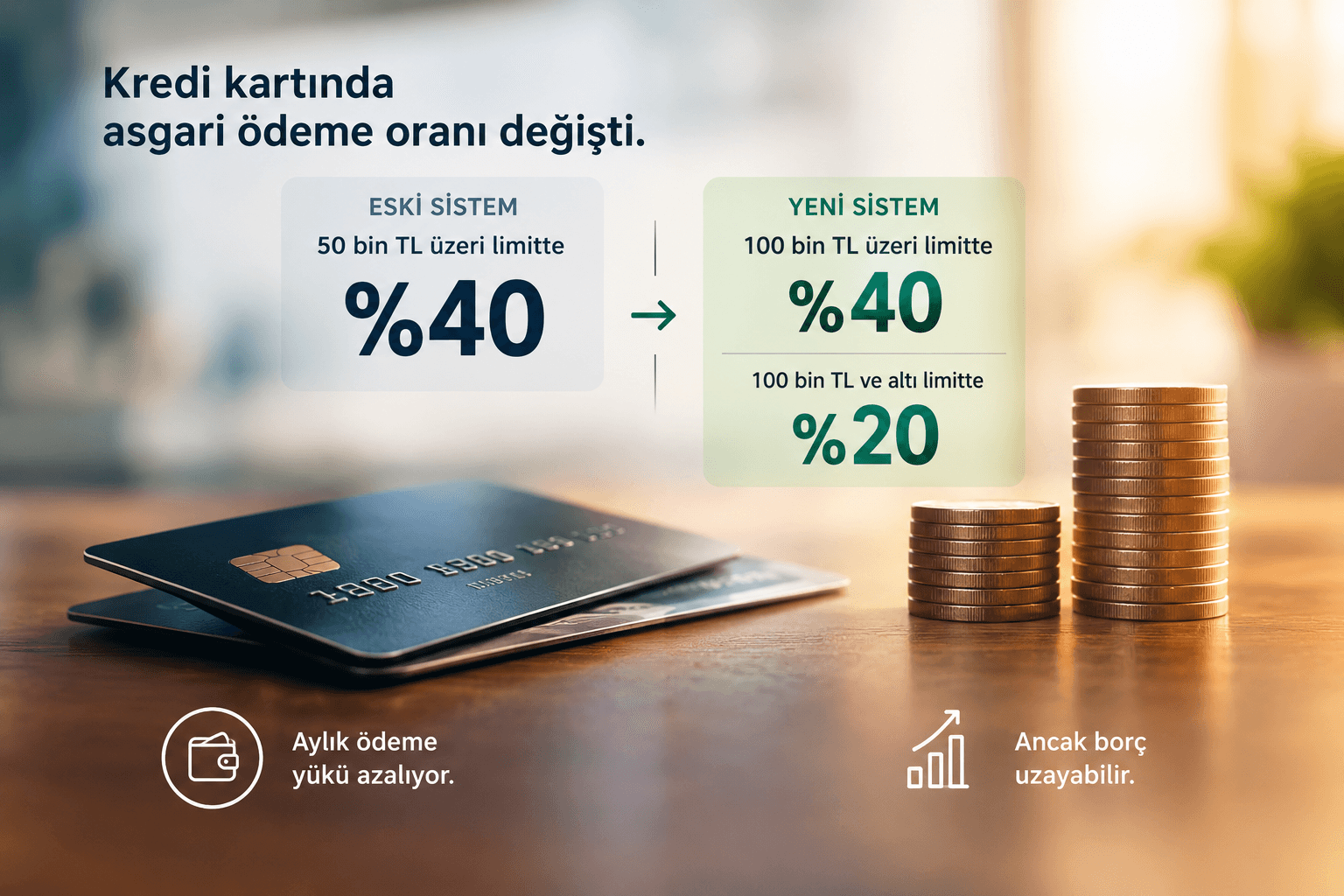
Can these rules be changed? Yes, they can. The most recent change was made only a few days ago. According to the regulation published in the Official Gazette, the minimum payment, which was previously determined according to the card limit, was set at a minimum of 30 percent for all cards, regardless of the card limit. For cards issued within the last year, at least 40 percent of the debt must be paid.

With the amendment to the Regulation on Bank Cards and Credit Cards published by the BRSA in the Official Gazette dated 13.06.2019, the minimum payment ratio, previously applied in tiers of 30 percent, 35 percent and 40 percent, was set at 30 percent for all credit card limits.
Accordingly, subparagraph (e) of the third paragraph and subparagraph (h) of the fifth paragraph of Article 17 of the Regulation on Bank Cards and Credit Cards, published in the Official Gazette dated 10/3/2007 and numbered 26458, were amended as follows:
“e) The minimum amount to be paid cannot be less than thirty percent of the period debt and, for newly issued credit cards, cannot be less than forty percent of the period debt until one year has passed from the start date of use.”
h) The minimum amount to be paid cannot be less than thirty percent of the period debt and, for newly issued credit cards, cannot be less than forty percent of the period debt until one year has passed from the start date of use, and the bank may set the minimum payment amount at no less than this amount,”
These ratios had previously been applied as 30 percent for credit cards with limits up to 15,000 lira, 35 percent for credit cards with limits between 15,000 and 20,000 lira, and 40 percent for credit cards with limits of 20,000 lira and above.
In this context, no change was made to the provision that, for newly issued credit cards, the minimum period debt to be paid cannot be less than 40 percent of the period debt until one year has passed from the start date of use.