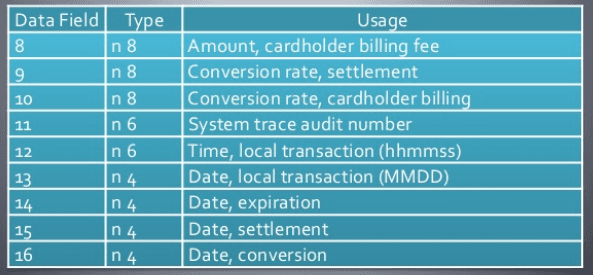
DE 10—CONVERSION RATE, CARDHOLDER BILLING: the cardholder billing conversion rate
It is an 8-digit numeric value. The first byte shows the position of the decimal point from the right, and the next 7 bytes show the value.
For example, the value 71121834 is interpreted as 0.1121834.
In which transactions is it used?
F10 is used when the transaction currency is different from the currency of the cardholder's account. For example, when a card linked to a Turkish lira account is used to shop abroad in euros, the transaction amount (F4) is in euros. The amount to appear on the cardholder's statement is sent in Turkish lira in field F6 (Cardholder Billing Amount). F10 shows the rate used to convert between these two amounts.
Formula
F6 = F4 × F10
In other words, the amount in the cardholder's currency is found by multiplying the transaction amount by the rate in F10.
Example
As in the example above, the first digit of the rate shows the number of decimal places. In the value 71121834, the first digit is 7, so the remaining value 1121834 is read with 7 decimal places from the right, and the rate is 0.1121834. Thanks to this structure, both very small and very large rates can be represented in a fixed 8-digit field.
Difference from F9
F9 is used to convert the transaction amount into the settlement currency, while F10 is used to convert it into the currency of the cardholder's account. If the settlement currency and the cardholder's currency are the same, the two rates may also be the same. The exchange rate seen on the cardholder's statement may be affected not only by the card scheme's rate but also by the foreign transaction fees applied by the bank.