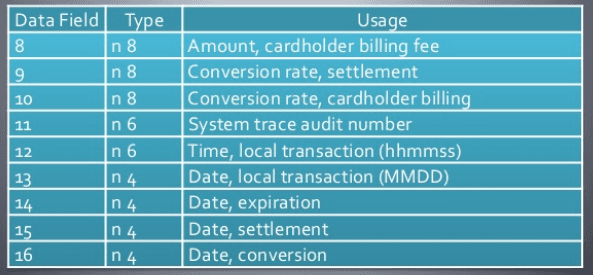
DE 12-TIME, LOCAL TRANSACTION: This is the local time at which the transaction took place at the point of transaction (ATM, POS).
It is 6 digits long, in hhmmss format.
The difference between F12 and F7
F12 shows the local time of the place where the transaction was carried out. F7 (Transmission Date and Time), on the other hand, shows the moment the message was sent, usually expressed in universal time (GMT/UTC). Since local time in Turkey is 3 hours ahead of UTC, there is usually a 3-hour difference between the F12 and F7 time values for the same transaction.
Used together with F13
F12 contains only the time. It is evaluated together with F13 (local date) to determine the exact time of the transaction. Together, the two fields show the date and time at which the transaction was carried out at the cardholder's location. The transaction time shown on the POS receipt and on the account statement is usually based on this information.
Why is it important?
- Dispute processes: When a cardholder disputes a transaction, the local time at which the transaction took place is used to identify the transaction.
- Fraud detection: Transactions carried out at night, or in different countries within a short period of time, are evaluated by risk systems using the local time information.
- Transaction matching: It is one of the pieces of information that helps locate the original transaction during cancellation and refund processes.
Accuracy of the terminal clock
Since the F12 value is taken from the terminal's own clock, it is important for the terminal clock to be accurate. A terminal with an incorrectly set clock causes transactions to be recorded with the wrong time. For this reason, banks usually update the terminal clock to match the host clock during parameter loading or end-of-day (batch) processing.