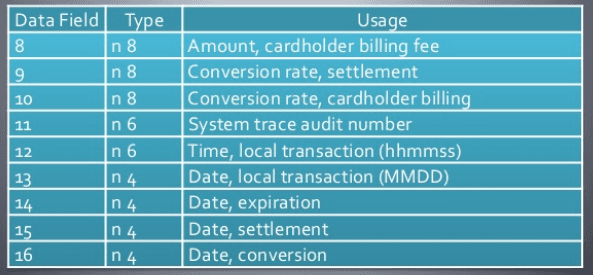
DE 13—DATE, LOCAL TRANSACTION: The date on which the transaction took place at the point of transaction (ATM, POS).
It is 4 digits, in MMDD format.
The difference between F13 and F7
An ISO 8583 message has more than one date field, and they are often confused. F13 shows the local date at the place where the transaction was made. F7 (Transmission Date and Time), on the other hand, shows the date and time the message was sent, usually in universal time (GMT/UTC). For example, for a transaction made in Türkiye just after midnight, F13 shows the new day, while F7 may still carry the previous day's date.
Why is there no year?
F13 contains only the month and day; it does not carry the year. The year is determined based on the date the message is processed. For this reason, care must be taken to determine the year correctly around year-end, for example for transactions made on 31 December and processed on 1 January.
Where is it used?
Together with F12, F13 shows the date and time the transaction took place from the cardholder's point of view. This information is used to identify the transaction in the cardholder's account statement, on the POS slip and in dispute processes. It is also one of the pieces of information that help find the original transaction in reversal messages.
Relationship with F15
F15 (Settlement Date) shows the date on which the transaction will be included in settlement. For transactions made after the end-of-day and clearing cut-off times, F15 may show the next business day, unlike F13.