F7 - TRANSMISSION DATE AND TIME:
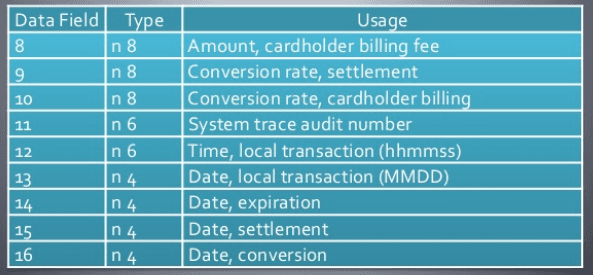
This field contains the moment at which the party initiating the transaction started it. It is a 10-character numeric value, in MMDDhhmmss format.
It must be kept stable throughout the transaction. In the original transaction's response, or in advice messages, this value must be sent identical to that of the original transaction.
Which time zone is it in?
The F7 field is generally sent in universal time (GMT/UTC). The local date and time of the place where the transaction took place are instead carried in the F13 and F12 fields. Since local time in Turkey is 3 hours ahead of UTC, there is generally a 3-hour difference between F7 and F12 within the same transaction.
Why must it be kept stable?
F7 is one of the fundamental fields used to identify a transaction. Together with STAN (F11) in particular, it uniquely identifies a transaction within the sending system. If the F7 value is changed in a cancellation (void) or advice message, the counterparty cannot match that message to the original transaction. For this reason, the F7 value from the original transaction is sent unchanged, carried in the F90 field, in subsequent messages.
Why is there no year information?
The F7 field is in MMDDhhmmss format, meaning it does not contain year information. The year is determined based on the date the message is processed. Around the New Year transition, for example, for a message sent on December 31st but processed on January 1st, the year must be calculated correctly.
Relationship with F37
In some implementations, the leading digits of the F37 (Retrieval Reference Number) value are derived from the date and time information in F7. For this reason, generating the F7 value correctly also ensures the reference numbers are generated correctly.