Innovations in the payment systems field continue every day. With rising costs as one of the drivers, the Regulation on Payment Services and Electronic Money Issuance and Payment Service Providers has been amended on this subject, and the relevant system has been redesigned.
In particular, the decisions taken on the minimum equity requirement will negatively affect the entrepreneurial world, and fintechs will come under the control of corporate firms.
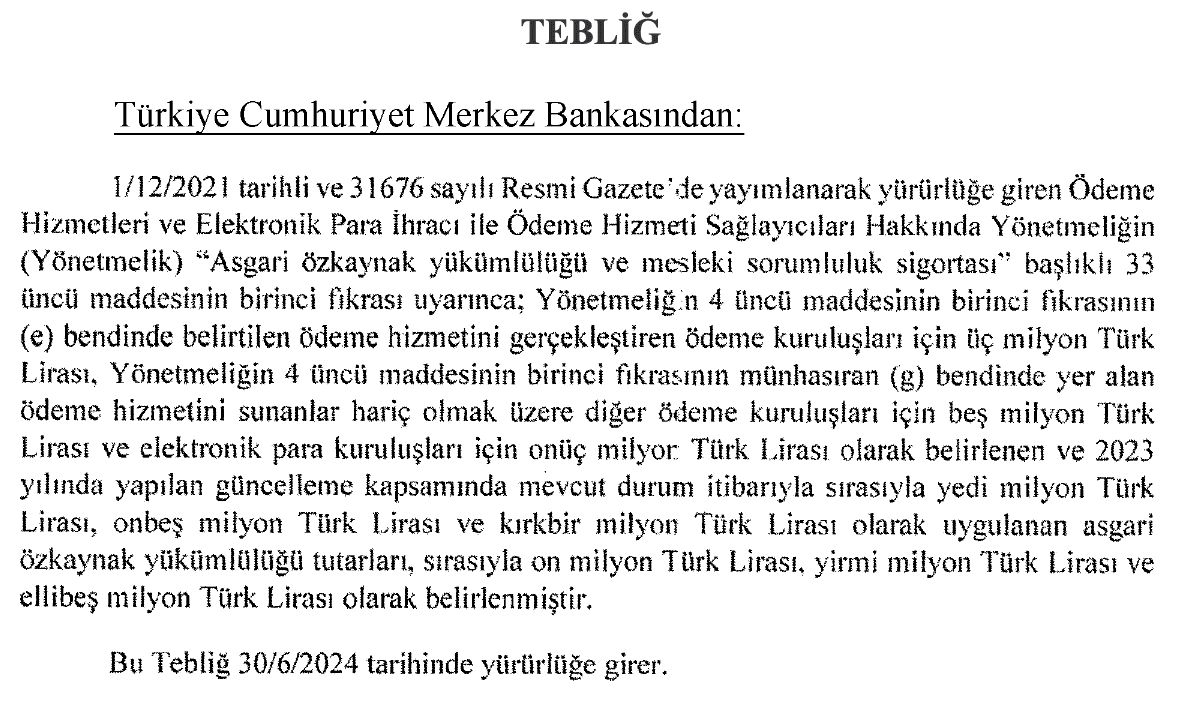
The Regulation on Payment Services and Electronic Money Issuance and Payment Service Providers of the Central Bank of the Republic of Turkey (CBRT) was published in today's issue of the Official Gazette and entered into force. The regulation, which sets out the procedures and principles for payment services and e-money issuance activities to be carried out effectively and without interruption, introduced comprehensive provisions on how institutions select and supervise their representatives. Bitcoin and similar crypto assets, and crypto assets issued on the basis of assets other than fiat currency, were left outside the scope of the regulation. The regulation details the activities that payment institutions and e-money institutions may not carry out, introduces a ban on extending credit, and places some limits on the foreign exchange buying and selling transactions of institutions. In the regulation, which reviewed the minimum equity requirement and the collateral mechanism, equity was set at no less than 3 million lira for bill payment institutions, 5 million lira for other payment institutions and 13 million lira for e-money institutions.
Account services to be provided to other payment service providers
ARTICLE 8 – (1) When another payment service provider wishes to use the payment account services and the payment services infrastructure services that a payment service provider offers, the payment service provider is obliged to offer these services to the requesting payment service provider under conditions similar to those applied to its other commercial customers, business partners and other payment service providers it deals with, without prejudice to obligations arising from legislation and to security, operational and technical requirements. Reasonable differences that may arise for commercial reasons in providing these services shall not be considered a violation of this paragraph.
(2) The services to be provided under the first paragraph must, as far as possible, be comprehensive enough to enable the requesting payment service provider to carry out the activity it wishes to perform under the Law without problems.
(3) A payment service provider to which an application is made under this article shall communicate its decision to reject or accept to the requesting payment service provider within one month at the latest. A payment service provider that rejects an application made to it under this article is obliged to give the requesting payment service provider the reasons for the rejection.
The relevant communiqué can be accessed at the link below:
https://www.resmigazete.gov.tr/eskiler/2021/12/20211201-1.htm