Now that credit cards play an ever-growing role in our lives, we carry out our purchases almost entirely without cash.
We inserted our card into the merchant's POS. We carried out a sale transaction for 100 TRY. We received the receipt confirming the transaction was successful. The following questions may be on our minds:
- How will the merchant receive its money?
- How will the card-issuing bank receive its money?
- Will I, as the cardholder, have to pay for the transaction I made?
Merchants generally perform their overall end-of-day checks manually before closing their shops. POS devices also carry out end-of-day (batch) operations, just like the merchant's own end-of-day checks.
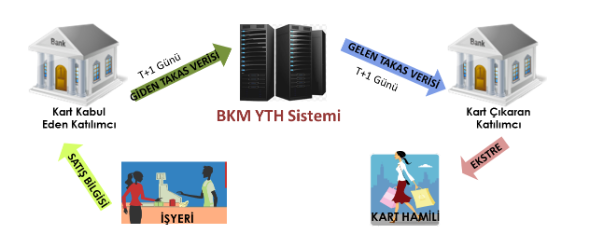
For example, let's assume a transaction of 100 TRY was made on 17.11.2018:
17.11.2018:
- The end-of-day operation is usually started through the POS menu by the merchant's authorized staff that same evening.
- The POS device sends all transactions stored in its memory to its own bank. The POS bank (acquirer) and the POS device reconcile the transactions.
18.11.2018:
- The merchant bank creates a clearing file for the 100 TRY transaction and forwards it to BKM. (Outgoing file)
- BKM creates a clearing file (incoming) for the card-issuing bank (issuer) and forwards it to the issuer.
- The card-issuing bank sends 97.68 TRY to the merchant bank after deducting the clearing fee. (Current clearing rate: 2.32%)
- The card-issuing bank posts the 100 TRY transaction to the cardholder's statement period.
- The POS bank credits the transaction to the merchant's account according to the agreed working terms. Assuming the merchant works on a commission basis; for the 100 TRY transaction made by the merchant, if the merchant has agreed to a 3.5% commission rate, the following day a 3.5% commission is deducted and 96.5 TRY is transferred to the merchant's current account.
- Assuming the credit card statement is cut on the 27th of each month, the cardholder pays the 100 TRY debt on 07.12.2018. The card-issuing bank then collects the 100 TRY amount.
So who bears the risk here, and who comes out ahead? Let's look at it from each party's perspective:
Cardholder:
In this process, the cardholder is not affected financially. They buy a 100 TRY product for 100 TRY. On top of that, they have the flexibility to make the payment over a period of 10 to 40 days, depending on the statement cut-off date.
Card-Issuing Bank:
The party that bears the risk in this process is the cardholder's bank. In exchange for the risk of receiving the 100 TRY amount in anywhere from 10 to 40 days at the earliest to latest (and this period extends further if the cardholder does not pay), the bank pays 97.68 TRY to the merchant. Moreover, if the cardholder does not pay their debt, the card-issuing bank faces the possibility of never receiving the 100 TRY amount at all.
Merchant Bank:
The merchant bank comes out entirely ahead in this process. There is no risk for the merchant bank in the transaction. The following day, while collecting 97.68 TRY from the card-issuing bank, it passes on 96 TRY to the merchant's account, coming out 1.68 TRY ahead.
Even though we might say the card-issuing bank takes on the risk while the POS bank is very profitable, it is still important to have a high number of cards in order to be able to deploy POS terminals, since it is hard to give merchants a POS without cards to use on it. In other words, the more cards there are, the more POS terminals there are 🙂



