PSD is a concept that stands for Payment Services Directive, commonly referred to as the Payment Services Law.
The Payment Services Law came into force in European Union countries in 2009. In 2015, new revisions were made and it was announced under the name PSD1.
With PSD1, the European Union's main goal was to develop an efficient, fast, secure, and competitive payment market among member countries.
The following steps were taken to develop this system:
- An area was created where the same rules apply to payment applications
comprising the European Union, Iceland, Norway, and Liechtenstein. - In addition to the payment systems already managed by banks,
a new payment service provider category was created under the name Payment Service Provider. This structure aimed to build systems that would compete with banks and open up the payment systems market to new players.
This marked major steps for the Single European Payments Area project. It also created an environment for many fintech startups focused on payment services to grow faster.
Payment systems startups that emerged from European Union countries and became globally known today include Transferwise, Azimo, Adyen, Earthport, Onescan, Judo, and Traxpay, among others.
In Turkey, under Law No. 6493, important startups such as iyzico, odeal, and ininal can be given as examples.
So what is PSD2, and what does it add to PSD1?
PSD2 emerged essentially as a revised version of PSD1, as a result of the rule that every law enacted in the European Union is reviewed after 5 years.
Adopted by the European Parliament on October 8, 2015, PSD2 is a more developed version of PSD1, which came into force in December 2007, with an expanded scope.
The new version was published in the Official Journal of the European Union on December 23, 2015, and came into force as of January 12, 2016, but member countries were given a certain period of time to align their legal regulations with the PSD2 criteria.
What kind of innovations and revisions does PSD2 bring?
- Expanding the framework for payment services beyond Europe to include payment transactions outside Europe
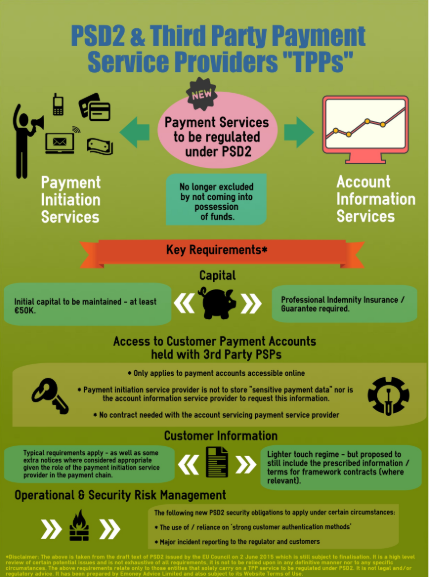
- Introducing the concept of Account Information Service Providers
- Introducing the concept of Payment Initiation Service Providers
- Introducing Strong Customer Authentication and identification criteria for payment transactions and access to financial accounts
Although Payment Service Providers were also defined in PSD1, with PSD2:
- new security criteria were introduced for the provision of these services.
- the scope of the services was extended beyond the European area.
- banks were required to open their payment services to third parties via APIs (Application Programming Interfaces).
PSD2, which came into force in Europe in 2016, is planned to be fully implemented by September 2019, along with the compliance process. With PSD2, banks will be required to open their customers' transaction and user information to third parties through secure APIs (Application Programming Interfaces). To do this, customers must first give their consent to share their transaction and user information. In this way, open APIs form the 'open banking' system.
With this information, which used to be accessible only to financial institutions, now also accessible to third parties who want to develop applications using this data, competition among financial institutions will increase, and we will see more innovations in financial services as a result of this increased competition. For example, third-party developers using customers' past shopping and account information will be able to identify customers' shopping habits (which sector they shop in the most, at what times they shop, how much they spend, etc.) and offer targeted marketing activities, recommendation systems, and financial management products. For this reason, the collaboration that financial institutions will establish with fintech companies will affect their success and the financial profitability brought about by innovation.
Has any work been done in our country regarding compliance with PSD2?
Like other countries, our country is also affected by this situation and will continue to be affected. Recently, KuveytTurk released a PSD2-compliant API service. Using this API service, which is a first in Turkey, developers can create new applications through the KuveytTurk system. With customers' consent for the application, access can be granted to account information, account activity, card transactions, credit information, and other transaction data, allowing more useful solutions to be offered to customers.
Considering the changes in technology and customer expectations, we can say that such developments will increase even further.



