Skip to content

Search

"Application Block"

32 articles found

Table of merchant sectors where offline transactions are restricted

Merchant & POS

In Which Sectors Can Offline Transactions Not Be Performed?

An offline transaction is one approved by the card and the POS themselves, without going to any system (the card's bank or the POS's bank), when a chip card transaction is made at a POS. For this reason, some sectors considered risky are restricted.


Illustration showing the consequences of entering an incorrect CVV2 code in an online transaction

Credit Card

What happens if I enter CVV2 incorrectly in my online transactions?

With the advancement of technology, the use of credit cards in online transactions and the variety of payment methods have increased. To make an online transaction with a credit card, you need: Card Number, Expiration Date, and CVV2 (the 3-digit number on the back of the card).

Illustration representing MCC codes used to classify merchants by category

Merchant & POS

What Is an MCC Code Used For?

Since the MCC code is a merchant's category code, it's critical for the checks performed during merchant onboarding and authorization, including campaigns and restrictions.

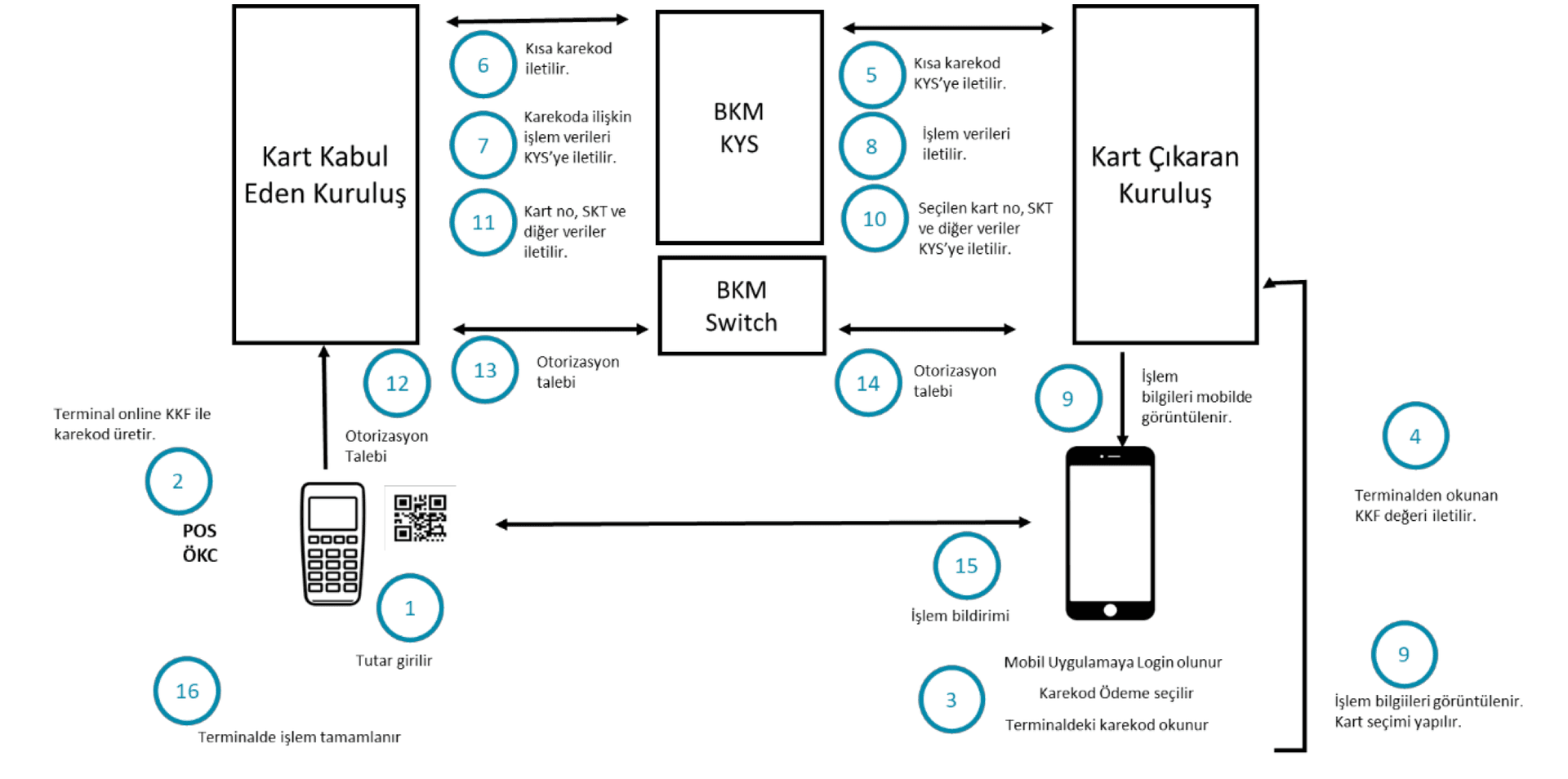
Diagram of the TR QR Code payment flow between cardholder, issuer, BKM and acquirer

Payment Systems

Why Am I Getting an Error When I Try to Pay with a TR QR Code?

In payment or cash withdrawal transactions, the TR QR Code is generated by the POS or ATM. The card issuing bank must build its systems to read and act on this code. Errors usually stem from mishandling the long and short QR code flows, which are explained here.

POS terminal device used to process chip card payments

Merchant & POS

What is Application Usage Control (AUC)?

AUC (Application Usage Control) specifies restrictions that limit an application by geography or by specific transaction types. It is a 2-byte data element in Tag 9F07. If present, the terminal performs checks such as whether the transaction is at an ATM.

Diagram of HSM use case areas in security and payment systems

HSM & Security

What Is an HSM? What Is It Used For?

HSM, short for Hardware Security Module, is specialized security hardware built to store sensitive cryptographic keys in a physical environment and to perform cryptographic operations in the most secure way.

Illustration representing the Card Protection Plan (CPP)

Security

What is CPP (Card Protection Plan)?

Credit cards are one of the most important payment instruments in daily life. As technology advances and mobile payments and ATMs handle nearly all transactions, credit card fraud is also diversifying and increasing.

Cryptocurrency mining concept illustration showing mining hardware and blockchain blocks

Cryptocurrency

What Is Cryptocurrency Mining?

Mining is the production of cryptocurrency through hardware and software, as well as the recording and confirmation of cryptocurrency transfers. Because block difficulty rises with each new unit, mining requires very powerful processors.

Diagram illustrating the ISO 8583 F55 field structure for ICC system related data

ISO 8583

ISO 8583 Field Descriptions (F55)

F55 - INTEGRATED CIRCUIT CARD (ICC) SYSTEM RELATED DATA: the field where EMV data is written on chip cards. It consists of components such as Position, Private Data Subelements, PDS Tag, PDS Length, and PDS Value...

EMV Lower Consecutive Offline Limit 9F14 illustration

EMV

What Is the Lower Consecutive Offline Limit?

The Lower Consecutive Offline Limit is the maximum number of consecutive offline transactions allowed by the ICC application, as set by the issuer, on a terminal capable of going online. It is sent in tag 9F14.

Illustration for a glossary of cryptocurrency terms such as Bitcoin, blockchain and mining

Cryptocurrency

What Are the Terms Used in the Cryptocurrency World?

Cryptocurrencies are becoming part of everyday life and are expected to compete seriously with card payments. This glossary explains the key crypto terms, from address, altcoin and arbitrage to halving, mining, proof of stake and stop-loss.

Diagram illustrating how bank fraud detection systems analyze transactions

Fraud

How Do Fraud Applications Work?

Fraud management is used to detect possible fraud on customer accounts and provides additional security for transactions when necessary, making it one of the top priorities for banks.