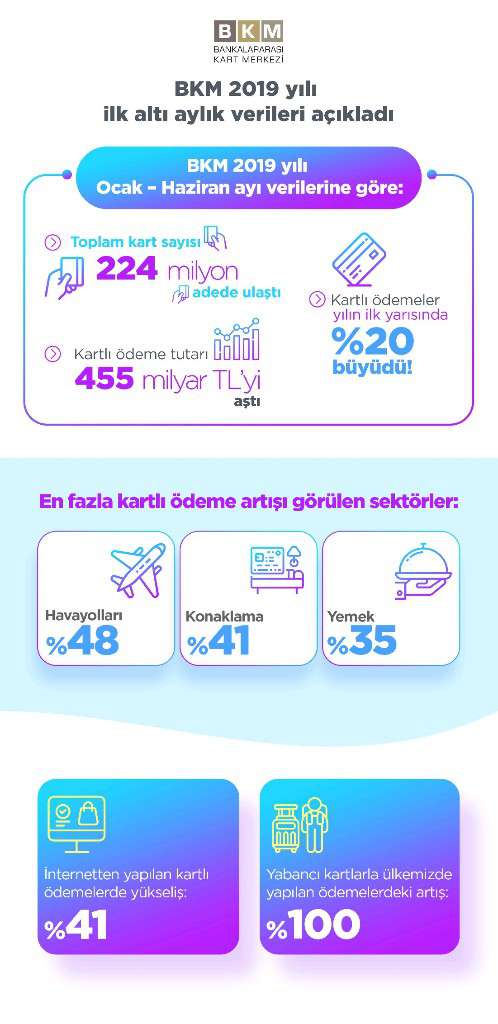
Payment systems statistics are reported periodically (semi-annually, annually, etc.) by the Interbank Card Center (BKM).
The report prepared includes;
- Total card count
- Total card turnover
- The growth trend of the card world in the relevant period
- The sectors with the highest proportional increase in card payments
- The growth trend of online shopping
- Results based on foreign card usage trends, etc. are included.
- how should we interpret it?
Total Card Count
The total card count has reached 224,000,000. Considering that the population eligible to hold a card (over the age of 18) is approximately 58,000,000, we can say that there are 4 cards per person. This shows how important a place cards hold in our lives. I think these 224,000,000 cards are cards that are active in status, rather than cards actively used by customers.
Total Card Turnover
Total card turnover has reached 455,000,000,000 TL. The average 6-month spending per card is 2031 TL, and the average monthly spending is 338.5 TL. This appears to be an indicator that cardholders do not actively use all of their cards. Since the report includes both individual and corporate card turnover, I think the average turnover for individual users will be somewhat lower.
The Growth Trend of the Card World in the Relevant Period
The card count and turnover figures above would not be very meaningful without growth information relative to the previous period. What makes the above 2 items meaningful is the increase value in the growth trend of the card world. A 20% increase in the growth trend of the card world compared to the previous period is a significant increase. There may be 2 reasons for this.
- With the developing world of payment systems, card payments taking place in every moment of life (transportation, online shopping, restaurants, etc.)
- With rising inflation, the decrease in cash on hand for citizens and the deferral of expenses by using credit cards
In order to determine the exact reason for this 20% increase, it is necessary to look at the card world's growth trend over the past several years.
The Sectors with the Highest Proportional Increase in Card Payments
Information on which sectors card payments are made in is determined according to the MCC (Merchant Category Code) sent by the merchant at the time of the transaction.
The sectors showing the highest increase are ranked as Airline 48%, Accommodation 41%, and Food 35%. This shows that we now prefer air travel over road travel, and that we have started using cards more for accommodation and dining transactions. Considering that the rate of credit card use for basic expenses has increased along with rising inflation, I expected grocery spending to also appear on the list. Frankly, based on the fact that the increase in sectors such as groceries and food is smaller than that of airlines, dining, and accommodation, we can interpret that the effect of inflation on card spending is smaller than expected.
The Growth Trend of Online Shopping
We can now carry out all our transactions within minutes via websites or mobile applications on mobile devices and computers. This is driving us to shop over the internet. The 41% increase observed in online shopping compared to the previous period shows the possibility of new players emerging online in the future and the potential for serious changes in market shares within the sector. The growth of the market means an opportunity for us, as cardholders, to obtain cheaper and higher-quality products more easily. I think it would not be unrealistic to expect even larger increases in online shopping transactions and turnover in the periods ahead.
Foreign Card Usage Trend
In the world of payment systems, foreign card detection is done as follows. Each bank's POS devices store the BIN numbers (the first 6 digits of the card) of the POS bank's own cards and the BIN numbers of domestic banks' cards. If the BIN number of the card used in a transaction on the POS is not among the BIN numbers defined on the POS, that card is considered a foreign card.
Now let's turn to the increase in foreign card transaction volume. Reaching a volume that is roughly 100% higher, or double, that of the previous period is a sign that our country is doing well in tourism. Tourists are now visiting our country more and spending more, contributing to the development of the economy. If the country information of foreign customers making transactions can also be obtained, spending by country can be reported and promotions and campaigns can be created for these countries.
What can we say; as we always say, "The CARD is the most effective payment instrument for those who know how to use it."
Use your card while keeping an eye on your income and expenses, and help bring the economy to life!



