Let us walk through the flow of a transaction made with a card on a POS:
We inserted our card into the merchant's POS. We made a 100 TL sale transaction. We received the receipt confirming that the transaction was successful. The following questions may be on our minds:
- How will the merchant get its money?
- How will the card issuing bank get its money?
- As the cardholder, will I pay for the transaction I made?
Merchants usually perform their general end-of-day checks manually before closing their shops. POS devices also run end-of-day operations, just like the merchants' own end-of-day checks.
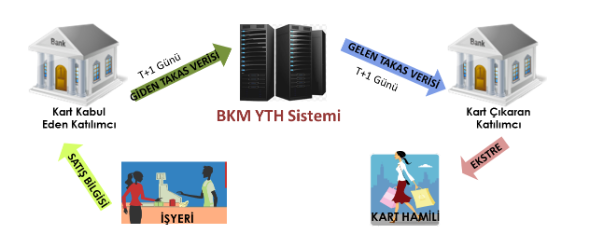
For example, let us assume a 100 TL transaction was made on 29.05.2020:
29.05.2020:
- The end-of-day (batch close) operation is usually started from the POS menu by the merchant's authorized person on the evening of the same day.
- The POS device sends all the transactions in its memory to its bank. The POS bank and the POS device reconcile the transactions.
30.05.2020:
- The merchant's bank creates a clearing file for the 100 TL transaction and sends it to BKM (Interbank Card Center). (Outgoing file)
- BKM creates a clearing file (Incoming) for the card bank (issuer) and sends it to the card bank.
- The card bank sends 98.77 TL to the merchant's bank after deducting the interchange fee. (Clearing rate: 1.23%)
- The card bank posts the 100 TL transaction to the cardholder's statement period.
- The POS bank credits the transactions to the merchant's account according to the working terms. Assuming the merchant works on a commission basis: if the merchant agreed to a 1.6% commission rate for the 100 TL transaction, the 1.6% commission is deducted the day after the transaction and 98.4 TL is transferred to the merchant's current account.
- Assuming the credit card statement is issued on the 27th of each month, the cardholder pays the 100 TL debt on 07.06.2020. The card bank has then collected the 100 TL.
To answer the question in the title: as the flow above shows, yes, it can.
If the authorization was obtained successfully, the merchant gets its money under the terms agreed with its bank, regardless of whether the cardholder pays the debt. The merchant is not concerned with the cardholder's payment. The card bank funds the amount it will pay the merchant itself until it collects it from the cardholder. If the cardholder does not pay the debt, the bank starts legal proceedings to collect it. If the cardholder pays the debt (100 TL), the card bank earns the difference between that and the amount it sent to the POS bank (98.77 TL), that is, 1.23 TL.



