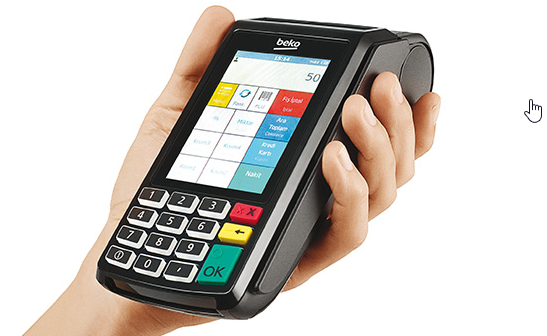
This is the limit held on the POS that manages the maximum amount for which an offline transaction can be performed. It is managed on a per-terminal basis.
Can the floor limit value be changed, or is it a fixed value set when the POS is installed?
The floor limit value is kept in the POS parameter management system. It can be updated whenever needed. For the POS to operate with the new floor limit, a parameter download is required.
For example, if a terminal's floor limit is 90 TRY, this means that transactions of 90 TRY or less may be carried out offline.
Because some banks consider offline transactions risky, they update their terminals' floor limit values to 0, ensuring that all transactions are carried out online.
How does the floor limit check work during a transaction?
In EMV transactions, after the terminal establishes communication with the card, it performs the "terminal risk management" step. In this step, the transaction amount is compared against the terminal's floor limit value. If the amount exceeds the limit, the transaction is always sent online, i.e., to the card-issuing bank. If the amount is below the limit, the terminal considers the transaction a candidate for offline approval. However, this alone is not sufficient.
Does every transaction below the floor limit go offline?
No. Even if the amount is below the floor limit, the following checks can still route the transaction online:
- Random transaction selection: The terminal randomly selects a portion of the transactions below the floor limit and sends them online. This way, offline transactions are also seen by the bank at certain intervals.
- Consecutive offline limits (LCOL/UCOL): The card counts how many consecutive offline transactions have been performed. If this count exceeds the limit, the transaction goes online.
- Terminal and card action codes (TAC/IAC): Rules defined on the bank and terminal side require online approval under certain conditions.
Floor limit in contactless transactions
In contactless transactions, a separate "contactless floor limit" is defined apart from contact transactions. In addition, the limit for transactions that do not require cardholder verification (the CVM limit) and the maximum amount allowed for a single contactless transaction are also separate parameters. These three values are often confused with one another.
Why is it considered risky?
In an offline-approved transaction, the bank cannot check the card's balance, limit, or lost/stolen status at that moment. The transaction only reaches the bank later, during the end-of-day batch and clearing process. For this reason, keeping the floor limit high poses a risk to the merchant and the bank, particularly in transactions carried out with counterfeit or blocked cards.



