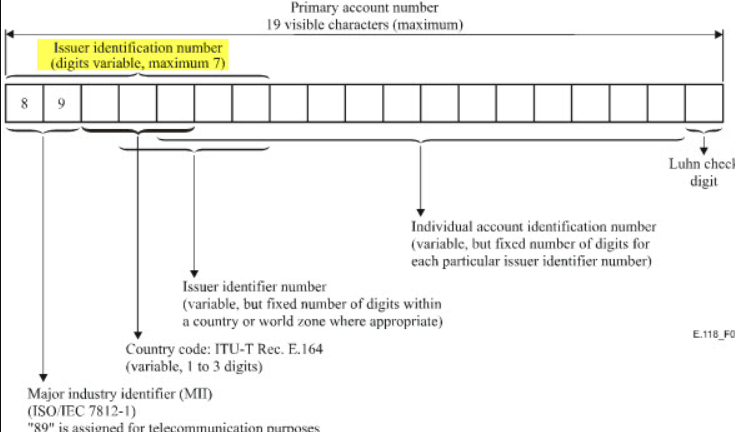
The ISO/IEC 7812 standard is primarily a standard that describes the card numbering system and the application and registration procedures.
Identification cards, whether in physical or digital form, are an integral part of the operations of businesses across many industries for identifying individuals. The common international system for numbering identification cards, and the application and registration procedures for issuer identification numbers (IINs), are determined by the ISO/IEC 7812 standard. It was first published in 1989 by the International Organization for Standardization (ISO).
The primary account number (PAN) of an identification card (such as a credit card) consists of three main components: the IIN (a number identifying the card issuer), the individual account number (intended to identify a single account by the card issuer), and a check digit (a digit calculated based on all preceding digits of the PAN according to the Luhn formula). The first digits of an IIN (and a PAN) generally indicate the type of organization in which they are used. For example, IINs beginning with "80" are used in healthcare institutions, and those beginning with "89" are used in telecommunications.
This numbering system is technically described in ISO/IEC 7812 in two separate parts, 1 and 2.
- ISO/IEC 7812-1:2017 – Identification cards – Identification of issuers – Part 1: Numbering system, is the first part of the identification cards standard.
- ISO/IEC 7812-2:2017 – Identification cards – Identification of issuers – Part 2: Application and registration procedures, the second part of the overall standard, covers the application and registration procedures for IINs.