Skip to content

Search

"card authentication"

50 articles found

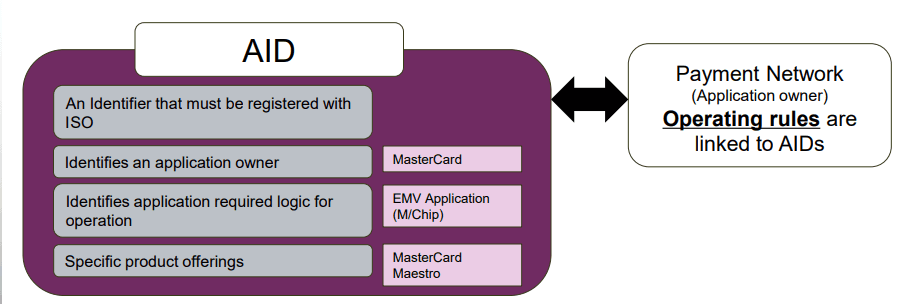
Illustration showing how an Application Identifier (AID) is used in a chip card transaction

EMV

What is an Application Identifier (AID)?

The AID tells the terminal which applications are present on a chip during a POS or ATM transaction. What does the AID do? It lets the terminal determine whether it supports an application on the chip. In Tag 9F06, it is 5-16 digits long.
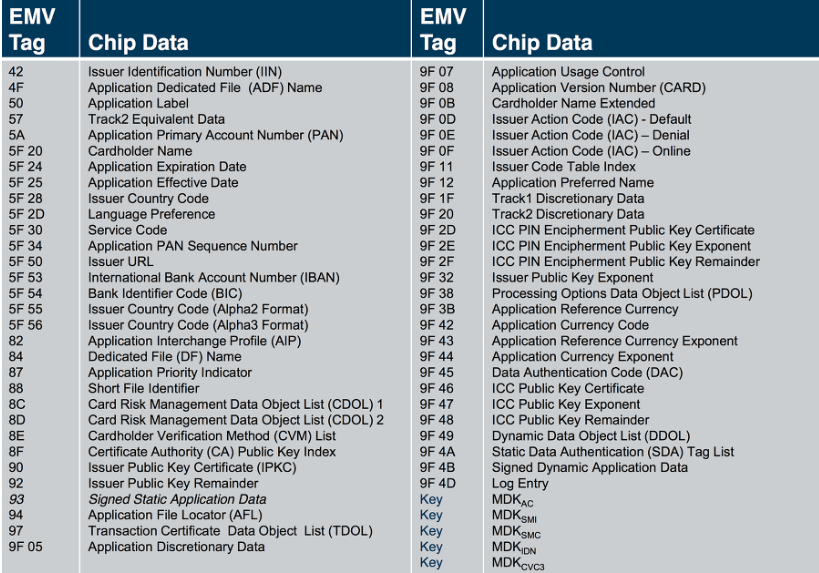
Diagram illustrating the EMV Tag-Length-Value (TLV) data structure used in card transactions

Online & Authorization

What are EMV Tags?

In EMV, data is stored in Tag-Length-Value (TLV) format, and it is carried between the card, the POS terminal, and the authorization system in this same format. This post lists every EMV Tag, its type, and its description.

Table of EMV Transaction Status Information (TSI) bit definitions

Merchant & POS

Transaction Status Information (TSI)

Contains the EMV steps performed by the Terminal in a transaction. The TSI fields, their possible values, and descriptions of the values are shown below.

Diagram illustrating the Access Control Server (ACS) role in the 3-D Secure authentication protocol

Security

How can I find the list of Access Security Control (ACS) companies?

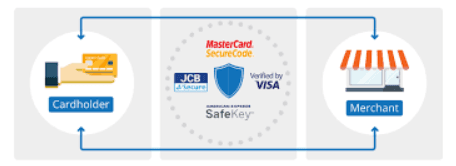
Access Security Control (ACS) is the security protocol that the card-issuing bank must maintain under the 3-D Secure protocol to support cardholder authentication. 3-D Secure is an XML-based protocol that adds an extra security layer to online card payments.

Diagram illustrating how a transaction's 3D Secure authentication level is determined

3D Secure

How is a transaction's 3D Secure level determined?

Especially with the growth of the internet, credit card transactions have started shifting from physical POS terminals to virtual POS terminals. In virtual transactions, the 3D Secure structure is used instead of the card PIN entered in physical transactions. So how is a transaction's…

Architecture diagram of the Visa EAS Server within the Visa Secure 3-D Secure authentication flow

EMV

What Is the Visa EAS Server?

The Visa EAS Server (Extended Access Service) is a server used in Visa’s authentication infrastructure. It was developed to run the cardholder authentication process securely between banks and the Visa network, particularly within Visa Secure (3-D Secure 2.x).

Conceptual illustration of AI agents engaging in online commerce and payments

Agentic Commerce

Agentic Commerce Series – Part 1

The next customer on the internet may not be human. If AI agents become part of purchasing decisions, the rules of e-commerce, marketing, and payment systems could change.

PIN pad screen on a payment terminal for entering a card PIN

Credit Card

What Happens If I Enter the Wrong PIN on Card Transactions?

Nearly all transactions where credit and debit cards are used physically require a PIN. The PIN represents the cardholder's identity. Here is what happens if a customer enters the wrong PIN too many times and how the card is restored.

Photo of a POS terminal related to EMV Issuer Action Code settings

Online & Authorization

Issuer Action Code (IAC)

These are codes that communicate the issuer's conditions for approving a transaction online (IAC-Online), for declining it (IAC-Denial), or for declining it when the terminal cannot go online (IAC-Default).

Diagram showing the EMV chip card static data authentication (SDA) process

EMV

What is a Data Authentication Code (DAC)?

DAC is the abbreviation for Data Authentication Code. It is a piece of data assigned by the issuer and held by the terminal during the Signed Static Application Data verification process.