Skip to content

Search

"card authentication"

50 articles found

Diagram of symmetric key types used in payment systems

HSM & Security

Types of Symmetric Keys

In the world of payment systems, keys and their uses are important for transferring information from one place to another, storing information, and securing authorization and scripting steps. Key types are divided into six categories based on their purpose.


Diagram showing the structure of an ISO 8583 message

ISO 8583

What Fields Make Up ISO 8583?

We covered the ISO 8583 basics in an earlier article. This post explains the ISO 8583 message structure in detail: every ISO 8583 message consists of three main parts - the MTI (Message Type Indicator), the Bitmap, and the Data Elements.

3D Secure opt-out online payment illustration

Merchant & POS

What Is Opt Out?

In online transactions, Opt Out is the cardholder exercising the right not to enroll in 3D Secure. It is not unlimited: only as many transactions as the issuer allows can be made without 3D Secure.

Diagram illustrating how a contactless offline transaction is processed

Merchant & POS

Can a Contactless Offline Transaction Occur?

A contactless offline transaction can occur. If the amount is lower than the floor limit defined on the POS and the card also allows offline authorization, the transaction can be completed offline. Offline transactions are periodically sent by the POS to the acquiring bank.

Diagram showing the role of the Access Control Server (ACS) in the 3-D Secure authentication flow

Security

What is Access Security Control (ACS)?

Access Security Control (ACS) is the security protocol that the card-issuing bank must maintain in 3-D Secure to support cardholder authentication, functioning as a complete authentication solution for issuers and payment processors.

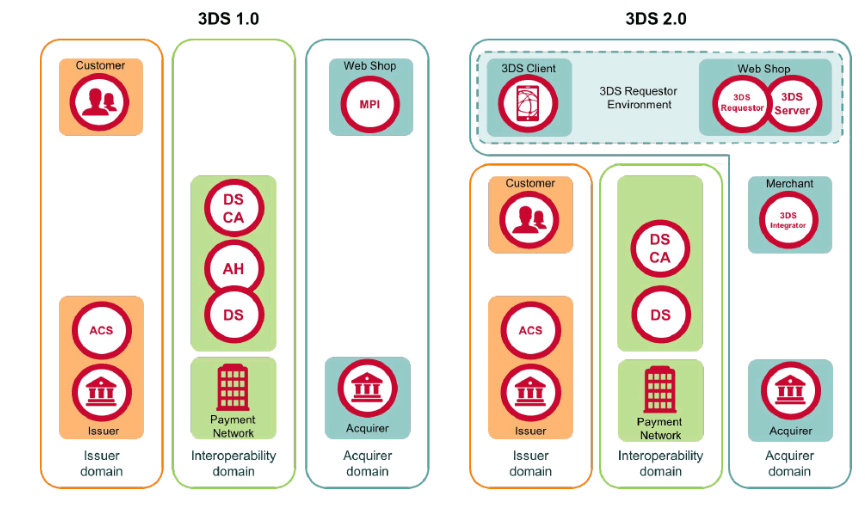
Architecture of 3DS 1.0 compared with 3DS 2.0, showing the issuer, interoperability and acquirer domains

Security

What Is 3D Secure 2.0?

Before 3D Secure 2.0, let's explain what 3D Secure is. 3D Secure is a two-layer payment authentication system that protects both the cardholder and the merchant in online payments. First released by Visa in 1999, it was later adopted by other card schemes…

GO Secure Payment logo

Merchant & POS

What Is Secure Payment (GO)?

GO Secure Payment is a system developed by BKM that verifies cardholders using a one-time password (OTP) during online purchases made with TROY cards, providing banks with a secure verification platform without needing to store card data.

Diagram illustrating the structure of the AFL (Application File Locator) field on an EMV card

Merchant & POS

What is AFL (Application File Locator)?

AFL (Application File Locator) is the field that shows where on the card the data needed for the authorization transaction is located. AFL is a list of the application data records on the card, and the terminal uses it to read the application data.

Diagram illustrating the ISO 8583 F55 field structure for ICC system related data

ISO 8583

ISO 8583 Field Descriptions (F55)

F55 - INTEGRATED CIRCUIT CARD (ICC) SYSTEM RELATED DATA: the field where EMV data is written on chip cards. It consists of components such as Position, Private Data Subelements, PDS Tag, PDS Length, and PDS Value...

Illustration representing communication protocols used in POS payment systems

Merchant & POS

What Are POS Sub-Protocols and Their Use Cases in Turkey?

In payment systems, every exchange between POS devices and bank or payment institution systems runs on a specific messaging standard, generally based on ISO 8583. However, each country, bank, or switch network defines its own version of this standard.

Screenshot of an Address Verification Service (AVS) response code table

Merchant & POS

What is Address Verification Service (AVS)?

Address Verification Service (AVS) is a fraud prevention system that helps limit fraud and chargebacks when used effectively. It verifies that the address a customer enters matches the cardholder's address on file with the issuer.

Illustration representing Strong Customer Authentication (SCA) under PSD2

Payment Systems

What is Strong Customer Authentication (SCA)?

Strong Customer Authentication (SCA) is a security requirement introduced under the EU's Payment Services Directive 2 (PSD2) to increase security and reduce fraud in online payment transactions. SCA requires two of three independent authentication factors.