Skip to content

Search

"issuing"

352 articles found

Stand-in authorization flow diagram

Credit Card

What is Stand-In Authorization?

In the standard authorization flow, the transaction is initiated by the acquirer (POS bank) and forwarded to the issuer (card-issuing institution). The process is completed once the issuer responds. However, this isn't always possible; when the issuer fails to respond, BKM steps in...


Illustration of customer-based contactless card limit management

Payment Systems

Can a Card's Contactless Limit Be Managed on a Per-Customer Basis?

Contactless payment has greatly improved the user experience, yet its fixed transaction limit is a common complaint. Can this limit be managed dynamically per customer? This post covers the current situation, technical and regulatory requirements and the outlook.

Illustration of a digital receipt delivered through a banking mobile app instead of a paper receipt

Payment Systems

Digital Receipt Era Is Coming...

The BRSA has introduced a regulation to reduce paper use in POS devices. Cardholders who do not want a paper receipt for card purchases will be able to receive and store it digitally, with the rules taking effect in September and December 2023.

Diagram illustrating the difference between Online PIN and Offline PIN verification in card payments

Payment Systems

What are Online and Offline PIN? Can PIN be bypassed?

Online PIN is verified by the card-issuing institution through the message itself, while Offline PIN is verified on the chip. This article explains the difference and when PIN bypass is allowed.

Contactless payment being made with a card at a POS terminal

Online & Authorization

When Does a Contactless Transaction Post to the Account?

A contactless transaction is a fast, secure payment made without direct contact between the card and the POS terminal (without reading the chip or magnetic stripe). Can every card be used for contactless payments? For a transaction to be contactless…

Diagram illustrating TCR (Transaction Record Component) packets used in payment clearing and settlement files

Payment Systems

What Is TCR (Transaction Record Component)?

TCR stands for Transaction Record Component, the packets that carry transaction information in a clearing system. Transaction types in a clearing file are distinguished by transaction code and usage code values, and this data is sent inside TCR packets.

Diagram illustrating the Access Control Server (ACS) role in the 3-D Secure authentication protocol

Security

How can I find the list of Access Security Control (ACS) companies?

Access Security Control (ACS) is the security protocol that the card-issuing bank must maintain under the 3-D Secure protocol to support cardholder authentication. 3-D Secure is an XML-based protocol that adds an extra security layer to online card payments.

Screenshot of an Address Verification Service (AVS) response code table

Merchant & POS

What is Address Verification Service (AVS)?

Address Verification Service (AVS) is a fraud prevention system that helps limit fraud and chargebacks when used effectively. It verifies that the address a customer enters matches the cardholder's address on file with the issuer.

Illustration representing credit card loyalty points and rewards

Merchant & POS

What are Loyalty Points?

Loyalty points are promotional rewards banks give customers for credit card transactions, tracked on a card/customer basis. Banks charge merchants a commission on POS transactions, and some share part of that commission with cardholders as points.

Virtual POS (VPOS) online payment interface screenshot

Merchant & POS

What is VPOS (Virtual POS)?

VPOS (Virtual POS) is the software-based, security-enhanced equivalent of the physical POS devices used for card payments at merchants, used for purchases made over the internet. It is also known as Virtual POS. VPOS is not issued to individual customers.

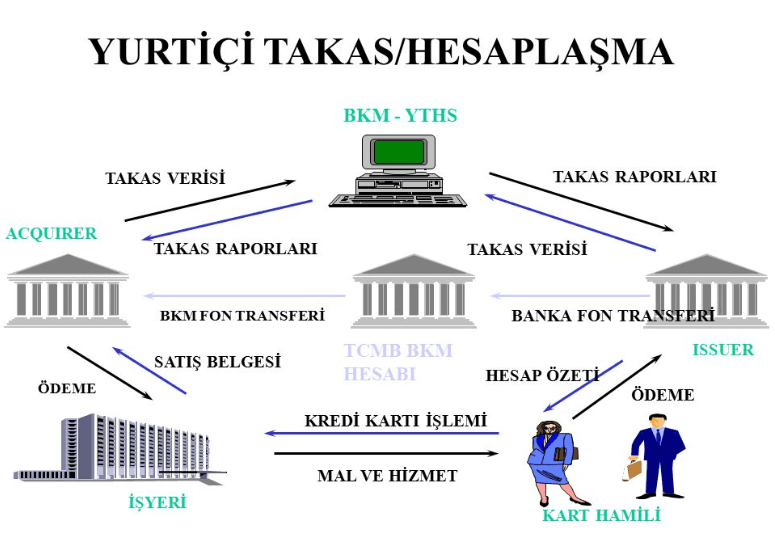
Diagram illustrating a Not Onus transaction between the issuer and acquirer

Merchant & POS

What does Not Onus mean?

Not Onus is a payment systems term meaning "Not On Us": a situation where the card-issuing bank and the POS/ATM (acquiring) bank differ. Such transactions are settled through clearing between the two banks.