
Online & Authorization
Application Version Number
The Application Version Number is the version number of the application on the card. For example, the Visa VSDC application version number is 131, and the Mastercard M/Chip Lite version number is 2.
Search
13 articles found
Online & Authorization
The Application Version Number is the version number of the application on the card. For example, the Visa VSDC application version number is 131, and the Mastercard M/Chip Lite version number is 2.
Online & Authorization
TLV is a data storage method used to speed up the parsing of data. For example, reading data from a card's chip at a POS and carrying it through authorization uses the TLV structure.
Online & Authorization
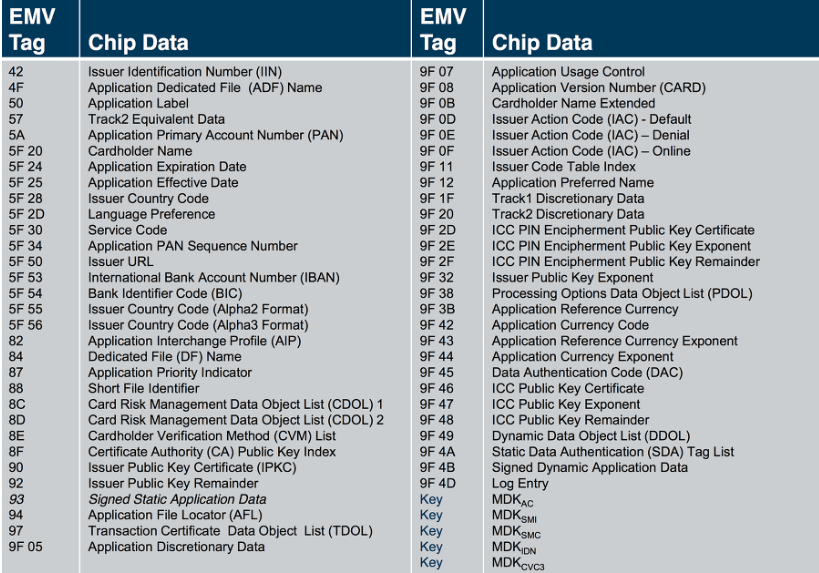
In EMV, data is stored in Tag-Length-Value (TLV) format, and it is carried between the card, the POS terminal, and the authorization system in this same format. This post lists every EMV Tag, its type, and its description.
EMV
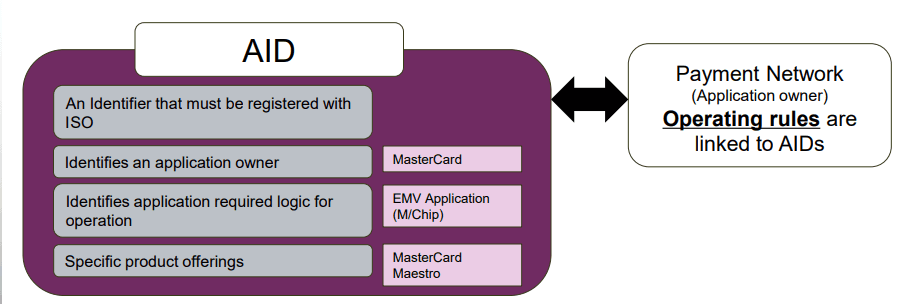
The AID tells the terminal which applications are present on a chip during a POS or ATM transaction. What does the AID do? It lets the terminal determine whether it supports an application on the chip. In Tag 9F06, it is 5-16 digits long.

ISO 8583
F55 - INTEGRATED CIRCUIT CARD (ICC) SYSTEM RELATED DATA: the field where EMV data is written on chip cards. It consists of components such as Position, Private Data Subelements, PDS Tag, PDS Length, and PDS Value...
ISO 8583
We covered the ISO 8583 basics in an earlier article. This post explains the ISO 8583 message structure in detail: every ISO 8583 message consists of three main parts - the MTI (Message Type Indicator), the Bitmap, and the Data Elements.

Merchant & POS
In daily credit card purchases, the POS produces two receipts: the Customer Copy and the Merchant Copy. The cardholder gets the customer copy; the merchant keeps its own copy by law.

Credit Card
KKB was established, under banking law, to enable the exchange of all kinds of information and documents among at least five banks, and it also shares credit information about customers. The Credit Bureau of Turkey also serves deposit banks, participation banks, financial institutions, and more.

Merchant & POS
VPOS (Virtual POS) is the software-based, security-enhanced equivalent of the physical POS devices used for card payments at merchants, used for purchases made over the internet. It is also known as Virtual POS. VPOS is not issued to individual customers.

Security
PAM (Personal Assurance Message) is a message that users set up for 3D Secure transactions. It appears on the password screen during checkout and confirms to the user that the screen truly comes from their own bank.

Merchant & POS
QR Code is a two-dimensional barcode system developed by Denso Wave, a Toyota subsidiary operating in Japan. Its name comes from the initials of Quick Response. Its content can be any data, including text, a website address, or a video link.

Payment Systems
Open banking opens financial data, under the regulations and with the customer's explicit consent, to third-party service providers through standard APIs. The CBRT has published a guide on payment initiation and account information services, covering licensing and technical certification.