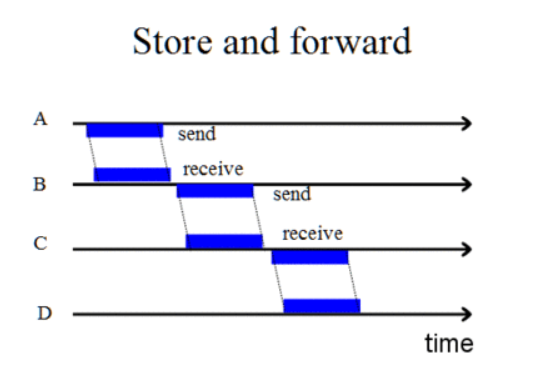
Store and Forward (SAF) is a term used to describe offline transaction processing.
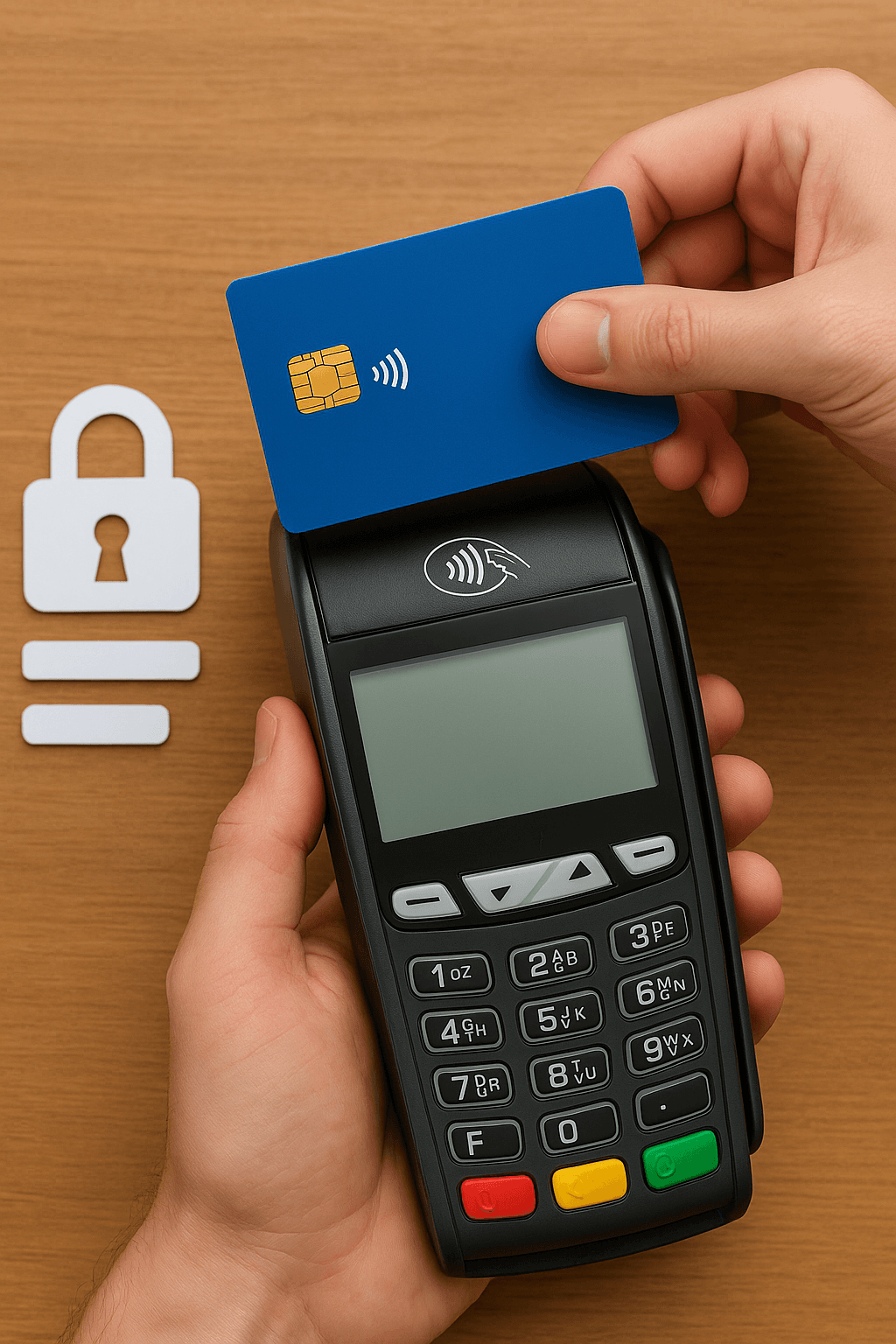
The concept of offline transaction processing was developed early on, when modems were first introduced and connections were not always stable. Offline processing is typically implemented at the payment terminal level, since the terminal is an independent device that operates separately from the host application. This approach is sometimes called store and forward. At a basic conceptual level, the terminal stores transactions and sends them to the host application for processing once connectivity is restored. The transaction is not actually submitted for immediate processing; instead, a "fake approval" is generated so that the sale can be completed. The real transaction information is then stored and processed once connectivity becomes available.
Store and forward is a capability that some terminals can run, allowing a terminal to carry out a transaction without being connected to a phone line. The transactions are then processed once a connection becomes available.
Most wireless terminals have store-and-forward capability for use when there is no cellular coverage. However, there are also some landline terminals that support store and forward. These terminals are much cheaper than wireless terminals, and some of them have battery packs, which makes them moderately portable.
A store-and-forward setup on a landline terminal can be a good solution for low-volume mobile businesses and can work very well as a backup.
Do all terminals support the store-and-forward structure?
No. Not all terminals support it. Some terminals do.
In general, Lipman "Nurit" terminals are the only terminals that support store and forward. Wireless terminals (Nurit 3010, Nurit 8000) can be programmed with store and forward at least through Nova and FDMS, and landline terminals can potentially support store and forward only on FDMS.
When it comes to battery-powered terminals, there are the Nurit 2085U, Nurit 3020U, and Nurit 8320U, which have battery packs. These terminals are harder to obtain than the standard models and will likely need to be special-ordered, but they are still much cheaper than a wireless terminal.
What are the advantages and disadvantages of the store-and-forward mechanism?
The advantage of the store-and-forward mechanism is that transactions that do not go through on the first attempt can be processed later and, in most cases, approved.
The disadvantage of the store-and-forward mechanism is that sometimes, once the system comes back online and the previously stored transaction is retried, it gets declined.
Systems that support offline transaction processing have to store card numbers for a period of time. As a result, the operators of such systems must pay close attention to PCI compliance and the related issues around storing cardholder data. Consequently, systems that use offline processing need to encrypt the tracking data or implement other approaches in order to minimize the PCI implications.
Offline transaction processing is best suited to e-commerce businesses where the customer does not take possession of the product immediately after the purchase, leaving some time for the transaction to be reprocessed. This approach also works for service providers (such as newspaper subscriptions), because in theory a service could be terminated (cancelled) the day after a customer places an order. Retail businesses, on the other hand, may find it difficult to use offline processing, because once a customer has taken possession of the purchased item, it becomes problematic to track that customer down if a transaction-processing issue arises after the purchase has been completed. This is why retail businesses generally only use this approach for small amounts.
There are two common scenarios for implementing offline processing. In retail businesses, it is usually implemented at the payment terminal level, while the same general approach can also be used at the payment gateway level. Some processors also offer offline transaction processing at the level of their own payment systems. Regardless of the level at which it is implemented, the general store-and-forward mechanism used for offline transaction processing remains conceptually the same.