When Does a Transit Card Become a Payment System?
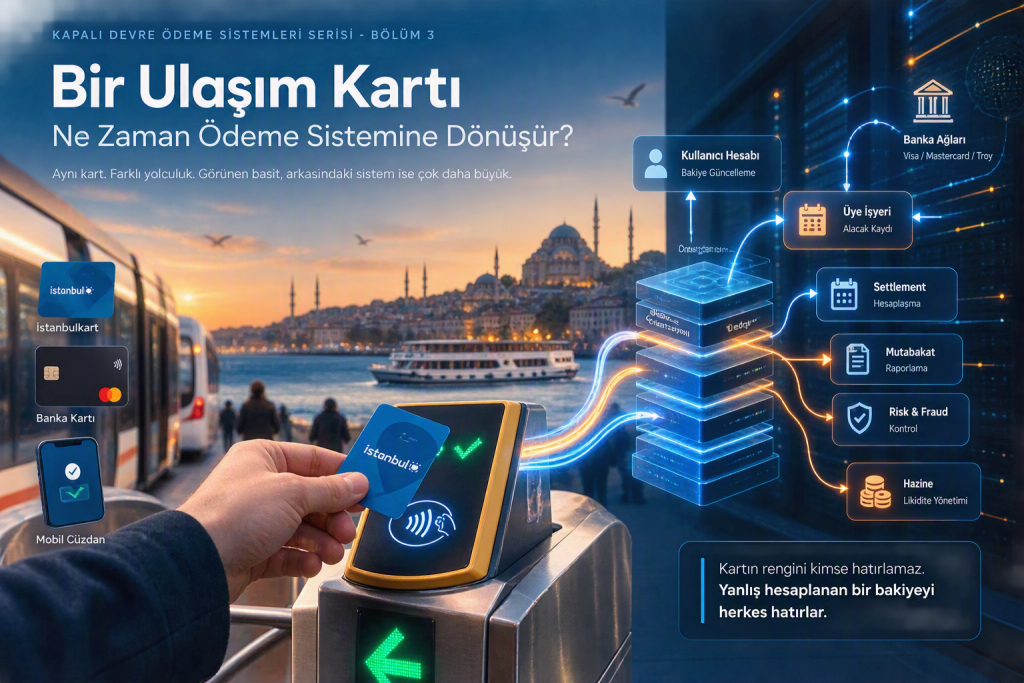
Millions of people living in Istanbul use Istanbulkart every day.
Passing through the metro turnstiles in the morning, trying to catch a bus, or boarding a ferry at the last moment, our hand goes almost reflexively to our card or our phone. We tap the card, pass through the turnstile, and a few seconds later we completely forget the transaction we just made.
In fact, most of us do not think of Istanbulkart as a payment system.
We see it as a transit card.
That is perfectly natural.
Because our purpose in using Istanbulkart is not to make a payment, but to get from one place to another.
So a small but important question comes up here.
What makes a system a payment system?
Is it the Visa or Mastercard logo on the card?
Is it being issued by a bank?
Or is it having a structure where people load money, hold balances and carry out financial transactions?
The answer to this question in fact also determines how we look at Istanbulkart.
Where does the line between a transit card and a payment system begin?
When we look at Istanbulkart a little more closely, we see an interesting picture.
The user loads money into the system.
This money is held within the system for a certain period.
It is spent in exchange for transit services.
Transactions are recorded.
Settlement processes run.
Reconciliation processes are carried out.
In fact, we also see a significant part of these in classic payment systems.
At this point, the following question inevitably arises:
If money is held within a system, payments are made and financial records are managed, is it enough to define it only as a transit card?
Or are we also facing a payment system?
In my view, the Istanbulkart example is important for exactly this reason.
Because this example forces us to question how a product works rather than what it is used for.
Is Istanbulkart still a classic closed-loop system today?
This question was much easier to answer a few years ago.
Because Istanbulkart was at the center of the system.
Istanbulkart was required to use transit services.
Money was loaded into the system through Istanbulkart.
Istanbulkart was again at the center of the ecosystem.
For this reason, Istanbulkart was cited as an example of closed-loop payment systems for many years.
But in recent years, the picture has begun to change a little.
Today, in some scenarios on Istanbul’s transit network, contactless bank cards can be used, and the EMV-based open-loop payment approach is becoming more visible in transit. In the same period, Istanbulkart has also moved beyond being just a transit card and has turned into a broader structure used for shopping and various city services.
The question that interests me here is this:
How should we define a system that continues to use its own card while also starting to accept externally issued payment instruments?
Is it still a closed-loop system?
Or is it now approaching a different category?
Rather than giving a definitive answer to this question, I think the question itself is what matters.
Because the future of payment systems may lie, in part, in the answer to this question.
Which direction are transit systems around the world heading?
Looking at the transit sector, we see similar transformations in different cities around the world.
In some cities, dedicated transit cards continue to be used.
In others, contactless bank cards can directly replace the transit ticket.
In some cities, there are models in which both approaches are used at the same time. EMV-based transit solutions are trying to build a bridge between precisely these two worlds.
The basic reason behind this transformation is actually quite simple.
Transit operators want to make it easier for users to enter the system.
They do not want a visitor arriving in the city to have to buy a new card.
They do not want them to deal with the card top-up process.
They want them to be able to join the system with the bank card or phone already in their hands.
At first glance, this seems a quite sensible approach.
But when we look at another side of payment systems, we come across examples that work in exactly the opposite way.
So why does Starbucks do exactly the opposite?
While transit systems try to accept users’ existing payment instruments, some companies try to draw users into their own ecosystems.
Starbucks is one of the best-known examples of this.
Starbucks has been encouraging its customers to use its own app for many years.
It gets them to use its own wallet.
It runs its own loyalty program.
It encourages customers to keep a balance within the system.
At first glance, this approach seems to contradict the trend we see in transit systems.
But in fact, the problems the two sides are trying to solve are different.
Transit systems are trying to make access easier.
Starbucks is trying to increase customer loyalty.
One side tries to open the doors of the system as wide as possible, while the other tries to keep the user inside.
For this reason, evaluating closed-loop and open-loop payment systems only from a technology perspective is often not enough.
One also needs to look at the business model.
The real question starts after this
In the first post, we talked about what closed-loop payment systems are.
In the second post, we examined the invisible architecture.
In this post, we tried to look at some of the products we use in daily life with a different eye.
But in my view, the really interesting question starts after this.
When a successful closed-loop system grows, does it have to turn into an open-loop one?
Or in some cases, could staying closed be a much stronger strategy?
Istanbulkart’s story says one thing.
Starbucks’ story says another.
Alipay and WeChat Pay give entirely different answers.
In the next post, I want to examine these examples a little more closely.
Because in my view, the way to understand the future of payment systems is not by looking at the cards in use, but by understanding which problem these systems are trying to solve.
And perhaps some structures that we see today only as a transit card, a loyalty app or a digital wallet will become the strongest payment networks of tomorrow.



