PIX is the last 4 digits of the AID (Application ID) value.
It allows the application provider to distinguish between the different applications it offers.
The PIX values by card scheme are listed below:
| Card Scheme | RID | Product | PIX | AID |
| Visa | A000000003 | Visa credit or debit | 1010 | A0000000031010 |
| Visa | A000000003 | Visa Electron | 2010 | A0000000032010 |
| Visa | A000000003 | V Pay | 2020 | A0000000032020 |
| MasterCard | A000000004 | MasterCard credit or debit | 1010 | A0000000041010 |
| MasterCard | A000000004 | MasterCard | 9999 | A0000000049999 |
| MasterCard | A000000004 | Maestro (debit card) | 3060 | A0000000043060 |
| MasterCard | A000000004 | Cirrus (interbank network) ATM card only | 6000 | A0000000046000 |
| MasterCard | A000000004 | Maestro UK (formerly branded as Switch) | 1 | A0000000050001 |
| American Express | A000000025 | American Express | 1 | A00000002501 |
| JCB | A000000065 | Japan Credit Bureau | 1010 | A0000000651010 |
| Diners Club/Discover | A000000152 | Diners Club/Discover | 3010 | A0000001523010 |
| Interac (Canada) | A000000277 | Debit card | 1010 | A0000002771010 |
| Discover | A000000324 | ZIP | 1010 | A0000003241010 |
| UnionPay | A000000333 | Debit | 10101 | A000000333010101 |
| UnionPay | A000000333 | Credit | 10102 | A000000333010102 |
| UnionPay | A000000333 | Quasi Credit | 10103 | A000000333010103 |
| UnionPay | A000000333 | Electronic Cash | 10106 | A000000333010106 |
| RuPay (India) | A000000524 | RuPay | 1010 | A0000005241010 |
The role of PIX in the terminal
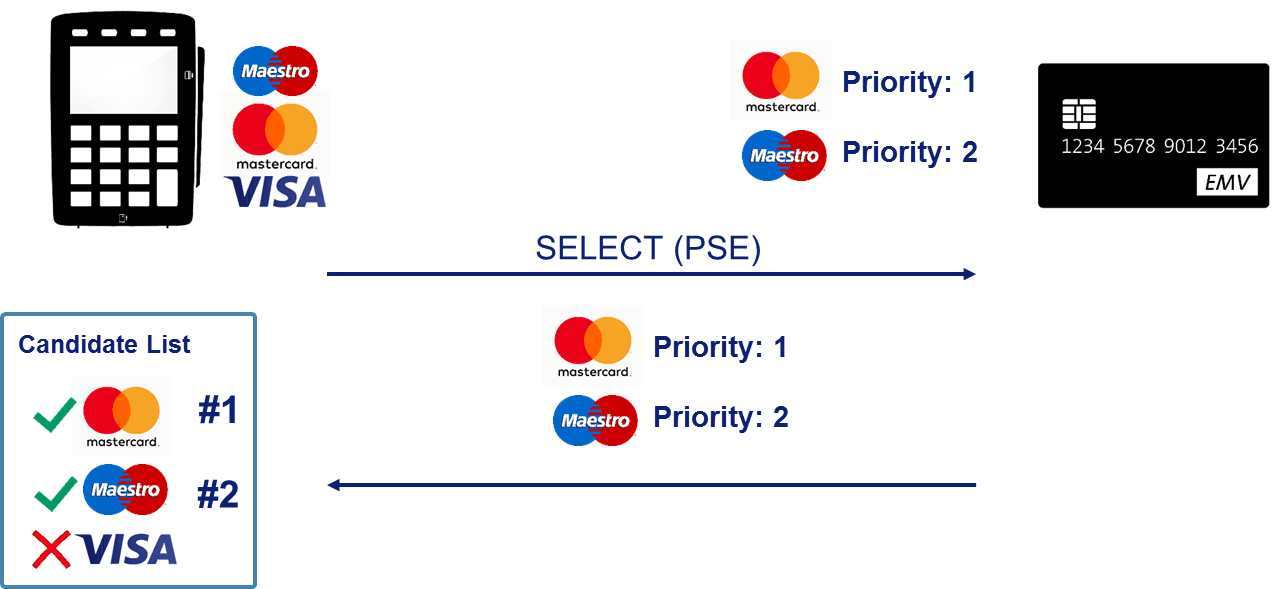
When the terminal reads the card, it compares the AID list of the applications it supports with the applications on the card. The RID, the first five bytes, identifies the owner of the application, while the PIX indicates which product of that owner is involved.
This way, credit, debit, and electronic card products belonging to the same scheme can be distinguished from one another. Terminal software may need to add a new PIX to its AID list in order to support a new product.
The values shown in the table are commonly used examples; each country and card product may require additional definitions.