Skip to content

Search

"chip transactions"

105 articles found

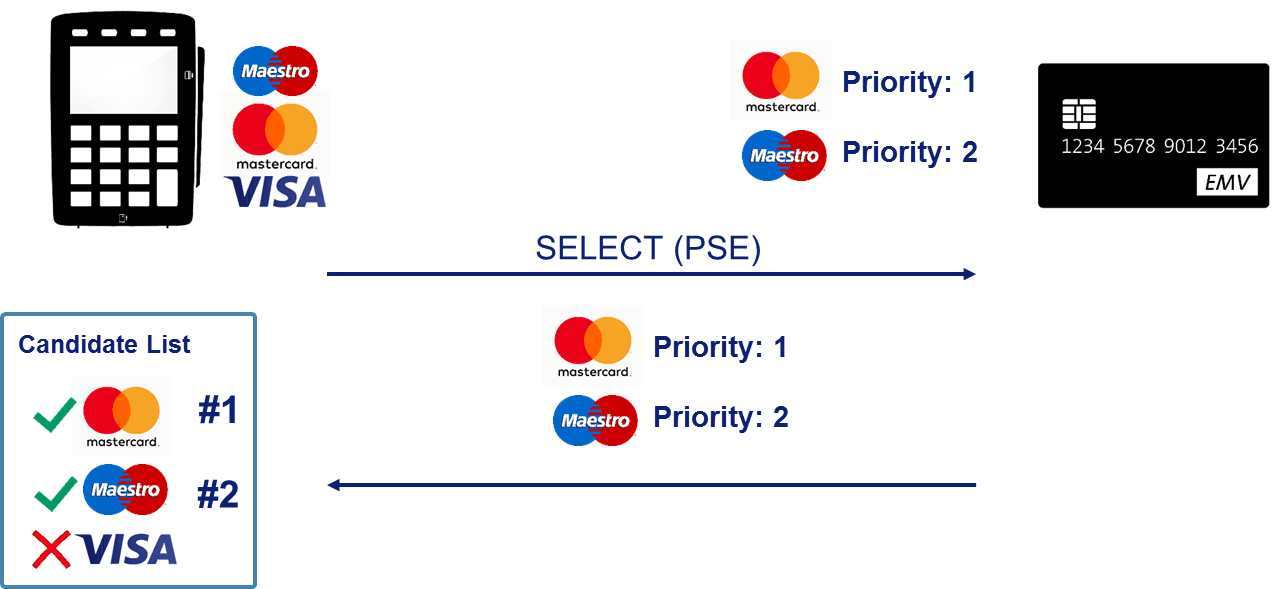
Diagram showing the PSE (Payment System Environment) directory used for application selection on an EMV chip card

Credit Card

What is PSE (Payment System Environment)?

PSE (Payment System Environment) is a directory on the card named 1PAY.SYS.DDF01 for a contact chip and 2PAY.SYS.DDF01 for a contactless chip. The Candidate List built via PSE is called indirect or implicit Application Selection.


Illustration for a glossary of cryptocurrency terms such as Bitcoin, blockchain and mining

Cryptocurrency

What Are the Terms Used in the Cryptocurrency World?

Cryptocurrencies are becoming part of everyday life and are expected to compete seriously with card payments. This glossary explains the key crypto terms, from address, altcoin and arbitrage to halving, mining, proof of stake and stop-loss.

Issuer Script Results field values shown on a POS terminal screen

Credit Card

Issuer Script Results

Issuer Script Results is the field that shows the results of the Issuer Script commands sent to the card. This post explains its byte and bit values, what an issuer script is, why the results matter, and what happens when a command fails.

Illustration representing Merchant Category Code classification for card transactions

Merchant & POS

What Does a Restricted/Prohibited MCC Mean?

The MCC code, or Merchant Category Code, is a 4-digit code used to classify merchants. Some MCC codes are restricted or prohibited, and POS terminals or card transactions may be blocked when such a code is used.

Diagram of chip card file structure showing MF, DF, and EF layers

EMV

What is Dedicated File Name (DFN)?

DFN is the abbreviation for Dedicated File Name. It defines the name of the DF (Dedicated File) as described in ISO/IEC 7816-4. It is the data found in Tag 84, 5 to 16 characters in length.

Diagram illustrating the ISO 8583 F55 field structure for ICC system related data

ISO 8583

ISO 8583 Field Descriptions (F55)

F55 - INTEGRATED CIRCUIT CARD (ICC) SYSTEM RELATED DATA: the field where EMV data is written on chip cards. It consists of components such as Position, Private Data Subelements, PDS Tag, PDS Length, and PDS Value...

Photo of a prepaid card used for everyday purchases

Credit Card

What should you know before buying a prepaid card?

A prepaid card is a customized chip or chipless card that is not linked to a bank account and has no credit limit like a credit card. You can only spend up to the amount loaded onto the card.

POS terminal processing an EMV chip card transaction

Credit Card

Application Interchange Profile (AIP)

The Application Interchange Profile indicates the application functions supported by the card. The AIP values and their descriptions are given below. Where is the AIP found? The AIP is a 2-byte piece of data stored on the card, carried under EMV tag 82.

Illustration showing different card printing methods

Credit Card

What Are the Card Printing Types?

While it is true that, with technological advancement, the trend of using payment transactions without a physical card via mobile phones has increased, there are many reasons why cards are still physically printed and delivered to customers.